Saturday, 2 May 2020

Spring 2020


Here is my latest piece for the Alyth Voice - the May number.


'Spring Steps

A conversation overheard on a bus the last time Louise and I visited Edinburgh led to a brief and informative exchange with our fellow passengers about those apps that tell you how many steps you have walked. Now I am smitten with an obsessive need to walk at least 10,000 steps a day. Well, that is all to the good. 

Thinning in one of the plantations gives me a reason to walk over and see how the work is getting on. This takes me through one of the latest plantings. 

Striding along one of the old tracks that passes through the ground we had planted in 2018 it is hard to avoid noticing the exposed tunnels of the voles. The place is pock marked with them. From time to time I notice that a sapling has had its stem gnawed, and bared of bark, by voles. Throughout the area, as a counterpoint to the signs of the voles, are abundant fox scats: they are everywhere, as are owl pellets. Every now and then you can see digging where a fox has tried to unearth a vole.

Around the outside of this plantation, whose little birch trees are showing the first signs of bud burst, is a heavy duty fence: high to shut out deer and netted lower down against rabbits. Here and there foxes and badgers have lifted the net and found their way through to hunt for voles and mice. When we realised that foxes and badgers were trying to enter the area during the winter of 2018 we arranged for badger gates to be installed. However, these seemed not to be used often or at all by those for whom they were intended, the foxes and badgers preferring to make new holes for themselves. This seems to me to be very understandable. If you were a fox or badger and knew about our species’ unrelenting persecution of their kind would you trust a gate that had been specially made for you? No, you would not. You would say, as our soldiers used to say, in the days of the war in Northern Ireland, ‘don’t go through the gate because it may be booby trapped. Cross the fence somewhere else.’ So, like good soldiers the foxes and badgers avoid the gate and make their own way through the fence, lifting the netting and pushing through. For the human managers of the plantation this is an irritation and an expense. A hole in a fence is an opportunity for unwanted visitors such as rabbits, capable of devastating young woodland, so they must be shut out, but it is also the access for the very creatures that you should want to help you establish the young wood by eating the tree predating herbivores. 

“Step on,” I say to myself and look at my iPhone see how many steps I have taken since I last looked a few minutes ago.

Another day, another walk; this time not so vigorous. I am back on a woodland path. It is warm. It is early afternoon. Birch and willow are coming into leaf. I rest on the trunk of a fallen tree by the burn. Well, fallen? It was felled some years ago by a beaver. Sap bleeds from a nearby stump.  I sit and watch and watch. The water gurgles past and a pair of buzzards flies overhead. Time to step on through the green pavilions of spring. Persephone is back from Hades.' 


The longer evenings and the growth of vegetation have made it much easier to see beavers going about their business. This one was grazing on the young grass growing around one of their pools. I have had wonderful sightings of otters hunting, playing and play fighting with each other. Similarly it has been wonderful to watch beavers play fighting together. It is curious to witness otters active at one end of the pool and hear a beaver gnawing something near the lodge. Next a fallen tree in the pool moor hens have made a nest. Seven tiny, black chicks have hatched out and will have to survive the otters in the pool that the beavers have made for them.


Every now and then I notice elm. Back in the '70s most English elm (Ulmus procure) in England were killed by Dutch elm disease. By the mid 80s most of the wych elm (U.glabra) in Scotland had gone the same way. We were told that any apparent recovery would be vitiated when, getting to a certain age, recovering elm would succumb again to the fungus bearing beetle. However, it does seem that some trees are getting beyond this stage and growing beyond bushes into trees. I came across this row of three or four elms growing along the old drove road that goes from Glenisla to Alyth. I hope they survive and become fine trees.


Walking on down this old drove road, a mallard duck flew up. I looked and saw her nest with its  clutch of eggs.


The Tay Bridge wood, a plantation of predominantly Norway spruce, planted in the 1950s, is in the aftermath of a good mast year. The ripe cones are being taken, and stripped of their seeds by the red squirrels. Visiting a Sitka spruce plantation here that is being thinned, I see masses of cones, but almost none that have been stripped of their seeds. 


And what about seed years and voles and El Niño?


Tuesday, 7 April 2020

More walks


A chance overheard conversation on a bus the last time Louise and I visited Edinburgh led to a brief and informative exchange about those apps that tell you how many steps you have walked. Now I am smitten with an obsessive need to walk 10,000 steps a day. Well, that is all to the good.


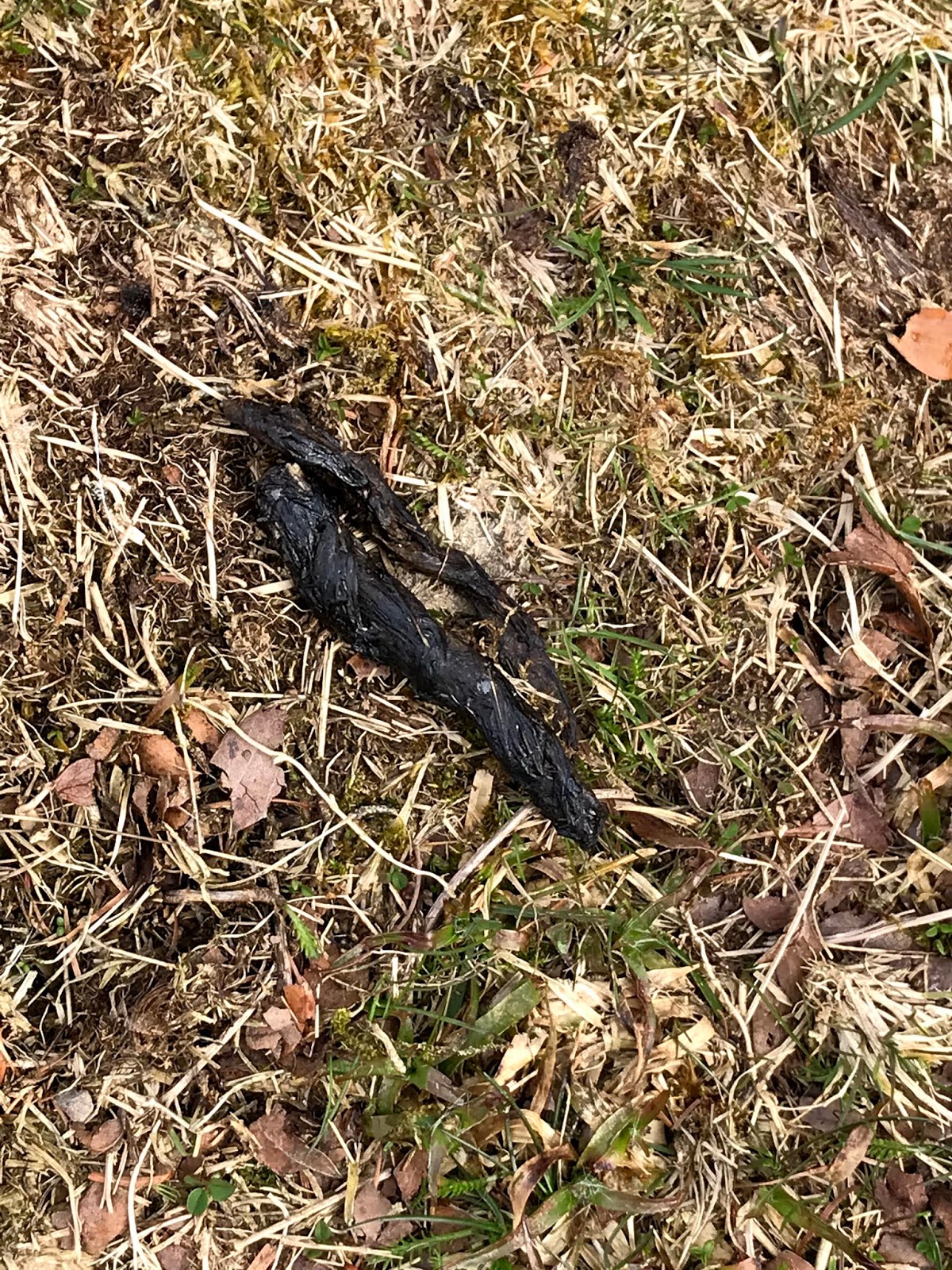
What is this photo of? The faeces of a mustelid, yes, but is it pine marten or stoat, or even polecat?


Walking through the Beaver Swamp I came across these foot marks of an otter. 


As March has turned to April I have become aware that the land is drying up. Muddy morasses are turning dry and baked. This is the season for forest fires and moor burn.


It is also the time when beavers, recognising that water levels are dropping are repairing breeches to dams that have been left unprepared through the winter. You can make out the dark patches where  fresh mud has been used to fill a gap.


My first primrose this spring, seen near the burn in the Burnieshead den. I expect that they are springing up along the drive as well.


A surprise greeted me when I went to get some feed for the hens this morning - four mice awaited me in the bottom of the bin. I photographed them and watched them running into the wood stack.


Sunday, 22 March 2020

Time for a Catch Up


It has got to be time for a catchup after months of silence. Here is my current offering to 'The Alyth Voice'

A Couple of Short Walks in Late Winter
Coronavirus… well, let’s give it a break and go for a walk. My default route is by the Burnieshead path, and then up and through the Tay Bridge Wood. I note, as always this winter, the abundance of cut and stripped stems of birch saplings, piled up against the high dam. These young birch have come from the regeneration on the bank above the burn. In late winter (early spring) when there are so few signs of new growth these fellings can look a bit extreme.  However, Spring is on her way. The coppiced saplings will push out new shoots in May, eventually to create a thick, branchy scrub, habitat for the insect life that goes with it. Warblers will rejoice.

Turning right to leave the path I climb the bank and walk in to the Tay Bridge Wood. Fourteen days into March, the stripped cones of Norway spruce are accumulating on the floor of the plantation. The squirrels are wearing through the winter stores, but there are still plenty on the trees. I see a cone stuck upright in the ground. A squirrel has raised it from the prone position. Is it easier for the squirrel to grapple with the cone upright to strip it of its seeds and eat them? But why did the squirrel leave that cone? A pine martin, a human, the shadow of a buzzard flying overhead?

Another day and I am walking along the bank of the main ditch. The winter storms have done much to rework the burn. New side channels, dug earlier by beavers, are now taking a share of the water that used to flow headlong down the straight, main channel. Sediments that used to lie on the channel floor of the burn have been swept on to leave a bed of coarse gravels and cobbles, habitat for young trout. Further downstream, where the water level has dropped since the latest floods passed through, and the current slows, these fine sediments have accumulated on the bank. Looking at the sediments I notice the foot marks of a small bird and pinpricks in the mud. What can have made these? The muddy bank makes me wonder if eels will return to these places one day.

A bird rises from the ground just ahead of me. I am still puzzling over its identity when another rises from the rushes. I get a clearer sight of the creature. It looks like a snipe, but smaller, and doesn’t make that ‘crick crick’ call at take off: jacksnipe, the two of them, I realise. I stand and watch for a moment before heading on again. Later, it occurs to me that those pinpricks in the mud were the work of the just disturbed jack snipe. The birds were using their beaks to probe the mud for food. They must be on migration, heading back to breed in Sweden, Finland and Russia after wintering with us, like the flocks of greylag on their way to Iceland.


Spring is with us. I know because I heard the chorus of the frogs over in the Beaver Swamp. Some years ago I managed to get some photos with which I was pleased of the creatures. 

The wet winter has resulted in the amazing expansion of waterways through the swamp. Walking about yesterday I took a few photos of things that struck me.


Magnificent works on the north side of the Beaver Swamp


Another view of this growing swamp.


I was surprised by this new dam, beautifully plastered with mud.


The first shoots of sweet reed grass (Glyceria maxima) - a fresh bite to cheer the beavers, water voles and other herbivores.


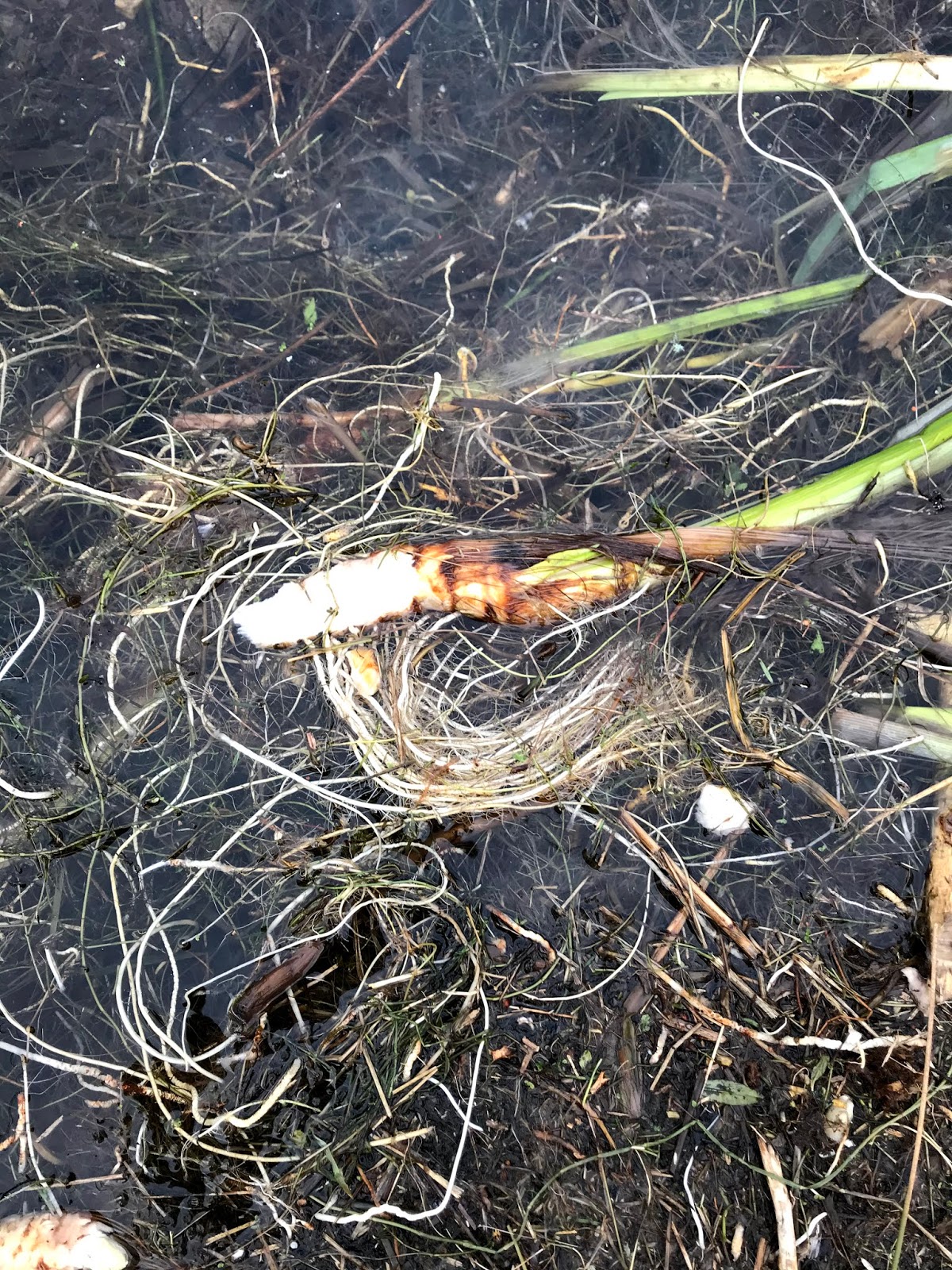
 Gnawed rhizome of yellow flag


Sunday, 11 February 2018

The Scottish Government's consultation on the restoration of the beaver to this country ends on the 6th March 2018.

The following is a letter that we are sending friends of the beaver and our Scottish Wild Beaver Group members.

It would be good to give a really strong signal to the Scottish Government that we should protect this returned native.


Dear Beaver friend / SWBG supporter

Soon the legislation allowing beavers to remain in Scotland will be debated in the Edinburgh Parliament. Before that can happen, the Scottish Government is obliged to issue a report and hold a public consultation on the conclusions of that report. The report was issued in December 2017 and the consultation is now underway. 

The Cabinet Secretary for the Environment indicated in 2016 that she is minded to allow beavers to remain in Scotland. However,  the final decision is not a forgone conclusion, and she may well be influenced by the results of the consultation and the subsequent debate in Parliament.

If you want beavers to remain in Scotland, please could you contribute your views to the 5 substantive questions in the consultation which can be found at the following link:


The deadline date for receiving responses is 6 March 2018 - and the more of us who reply positively, then the more likely the Cabinet Secretary will be persuaded to stick to her initial decision to allow beavers to stay. As we have seen in the press recently, those who are opposed to beaver’s presence in Scotland can be very vocal - and we need to make our voices heard.

The government report on beavers in Scotland is technical and lengthy. So to make responding to the 5 questions easier, we set out below a summary of the answers that Scottish Wild Beaver Group has provided to the consultation. You should of course, feel free to respond to the questions as you see fit. If you feel uncomfortable or unqualified to answer any particular question, we suggest you just leave it blank.

Please help us to keep beavers in Scotland - by responding to the Consultation by 6 March

Kind regards


Louise Ramsay

Convener Scottish Wild Beaver Group

Question 1
Do you agree with the re-introduction policy and that the Environmental Report has correctly identified the potential impacts and appropriate mitigation?

-Yes ✔
-No
-Unsure

Please explain your answer
We strongly agree that beaver populations in Scotland should be allowed to remain,and that beavers should receive strong legal protection.
Beaver bring many benefits such as flood risk reduction, improved water quality and increased biodiversity.
In addition their presence has socio-economic benefits  (such as  ecotourism potential)
Beavers should be actively managed to reduce any negative effects on farmers, but culling should only ever be a very last resort after all other mitigation methods have been exhausted

Question 2. 
What are your views on the evidence set out in the Environmental Report that has been used to inform the assessment process?
Very positive   
-Positive ✔
-Neutral
-Negative
Very Negative
Please give details of additional relevant sources:


The evidence contained Environmental Report is generally detailed and thorough.

Question 3
What are your views on the predicted environmental effects as set out in the Environmental Report? See page 15 and Section 4
Very positive
Positive ✔
Neutral
Negative
Very Negative
Please explain your answer

The report’s findings on the predicted environmental effects of beaver reintroduction are generally comprehensive and well reasoned. 

Question 4 
Are there any other environmental effects that have not been considered?

The creation of riparian buffer zones (involving beaver dams) could potentially provide a critical solution to combatting agricultural run-off pollution in intensively farmed areas. 

Question 5 
Please provide any other comments you have on the environmental report
The environmental Report has correctly identified the the potential impacts and appropriate mitigation – but it will be critical to see how the identified mitigation measures are implemented in practice, that sufficient funding is made available for beaver management, and that any evidence of wildlife crime involving beavers is swiftly investigated and prosecuted.


Saturday, 3 February 2018

Runoff and Dams


I was surprised when I found this pool of muddy water as I walked through the beaver swamp here at Bamff. I used to call this the 'Wet Wood', but the character has changed so much with all the work that the beavers have undertaken over the years.


Downstream of the dam the water was clear.


I went in search of the source of the muddy runoff and found that it started with a puddle on the public road.


The water flowed down this ditch. The dam in the first photograph is a few yards round the corner in the distance.


some of it flowed into this tributary of the main ditch and 


flowed into this pond. You can see the lighter sediment laden plume of water. It is joined by another sediment rich body of water that has run off a nearby field. The direction of flow is towards the dam in the top right of the photo, built by the beavers that inhabit this swamp.


Here is the dam through which the muddy runoff must flow. I think it is between 70 and 80 paces long.


This shows the clean water that the dam has filtered.

It was good to see such a clear example of the capacity of beaver dams to stop excess sediments. I suppose that the water on the road contained traces of oil, rubber from tyres and so on. 

Wednesday, 23 August 2017

Oh dear, about two months since my last post!

(I have just noticed a draft today, 23 August 2017, and thought I would write a bit more, add a couple of photos and post it all the same.)


Well, here goes!


That was back in May, I see. The beavers in the burn/ditch west of the drive have been doing great things. I notice tree stumps I had thought were dead sprouting coppice shoots.


A hazel stump sends out coppice shoots.


An ash does the same. I fear for the ash here because I see many signs of the ash die back.


Water spearwort is a spreading feature of the burn side.


Time for a Catch Up


Here is my contribution to 'The Alyth Voice' for August 2017

A Burnside Drama

High summer! A brilliant day of sun with thermals to send buzzards soaring. Swifts fly screaming at altitude and the swallows dart out from their nests on endless sorties. Perhaps there is a second brood to raise?

Life moves on. There are new routines to adopt. Recently, and don’t tell the foxes, pine martens, badgers, stoats, pole cats and others who might be interested, we bought six pullets from Mrs Bruce at Woodside. Now they are here I have to alter my routine to include them in it. They must be shut into their house at night and let out by day to wander and forage through what was once a tennis court. They must be supplied with food and their water supply maintained. Well, that is one new responsibility. Luckily the world is full of people who know about poultry.

Next, a researcher has installed a notched weir and various devices with which to record the flow of water along the Burnieshead Burn. Unfortunately beavers react to the sound of flowing water by going to check where it is coming from. If the flow results from an overflow that they have made themselves they leave it, but if the flow is unauthorised, so to speak, they will do their best to block it. This is what they are doing with the researcher’s notched weir. What is he to do with the situation? The altered flow resulting from the beavers’ work will affect his data. A solution must be found. For the moment I have to visit the notched weir every day to remove the beaver’s efforts of the night before. Perhaps they will give up?

After clearing the notched weir one day I walked on, turned left over the bridge that used to carry the drive to the house, and took along the northern endrigg of the field called Dance Naked. I stopped half way along by the big beech tree that stands there, and looked in towards the burn. A substantial area had been cleared of nettles, dockens and thistles. Climbing over the fence, I went to look more closely: a path led from the top of the bank into the burn: a beaver had cut this clearing among the bankside vegetation. I was fascinated because I had thought that the animals avoided plants like nettles and thistles: clearly not. Beavers do create characteristic areas of lawn along the banks of water courses, but my impression has been that they graze the tender species and leave the more fibrous grasses. I left the bank and crossed the fence back into the field.

I trod on my way, reflecting on what I had just seen, when I noticed a detached foot on the ground. I looked more closely. It was the right hind paw of a beaver kit. What could have done this? A few paces on and I noticed the rest of the creature among the rushes by a canal. All that remained of the little animal was its tail, skin and a shoulder blade. Some beast had scrobbled the kit and consumed it. 


After their first six weeks of life, when their parents keep them safe in the lodge, beaver kits can become surprisingly bold. They seem keen to explore their surroundings, while their parents stand guard nearby, mostly. Perhaps something distracted the parents’ attention in this case? A careless moment is enough to allow the alert hunter its chance.

Otters are around, so my suspicions fell on that species, but perhaps a badger had caught the beaver, or a fox? A Belgian correspondent has told me that it could have been a wolf in his country. So it goes.


Here is my contribution to the AV for September:


A Cock and Six Pullets

As August heads into September the first hints of autumn are becoming apparent; a touch of colouring on the crowns of trees, heavy dew on the grass. The swifts have been gone since early in the month. The house martins and swallows fly in gathering masses to catch their insect prey and fatten on it before setting off for Sub-Saharan Africa.

The pullets I bought in July have started to lay and to make some points clear about their contract with me as custodian. They made it plain very soon after arrival that confinement to their pen was too restrictive. No amount of reminding them of the danger of predators would make them change their mind. Every day as I went to visit their pen they would rush to the door and push as I opened it. Eventually I gave in and allowed the six to rush out, bearing at the back of my mind the thought that I owed them a duty of care as their protector. 

Once out they picked and pecked at the fresh blades of grass. They scratched at the ground with their feet. As the days have passed they have grown bolder and wander further afield. In the afternoon I round them up. Well, that gives you a rather inaccurate idea of what happens. I look around a hen-less landscape and wonder which of several species of predator will have enjoyed them. Perhaps it will be the fox I saw from our bedroom window recently, or the otter whose paw mark I saw by the burn yesterday? And there are pine martens and possibly polecats, not to speak of stoats and weasels. Then, all of a sudden, I hear the reassuring, conversational ‘toouck, toouck' of a hen. Two of the creatures have walked out of the undergrowth where they have been foraging. Soon most of them have come out into the open, curious to see what is going on.

An email arrived from friends in Argyll. They had bought a fine bantam cock for their hens and no longer needed the full sized beast they had on the strength at the time. At first I was unpersuaded: we didn’t need a cock for our hens. We were not planning to establish a breeding flock. Then, another email arrived.The cock in Argyll would face death if he could not be given away: an axe was at hand. Our friends would delay execution if we accepted the bird: they would drive him over to us. He was of a kindly disposition, would look after our hens and protect them from evil. He would even sacrifice himself rather than let his hens face death at the claws of a predator. 

This was too much for me. I emailed back immediately that the cock must come to Bamff without delay. He would be granted full rights of residence as an asylum seeker in danger of his life.

The cock has turned out to be a splendid red gold specimen with iridescent green black tail feathers, which include a white one for good measure. Our friends told me that he had an exceptionally pleasant character, was very quiet, would only crow at dawn and then only for a short time. We drank tea and I listened while my friends extolled the cock.

What of the reality on day two of his presence? He wandered round the house all day, crowing quite often. When it came to rounding up the hens in the afternoon he had only two with him. Is this the future, I thought, am I condemned to an old age of rounding up hens every day from two hours before dusk?


In the meantime our consumption of eggs has risen. Omelettes, scrambled, boiled, poached and fried eggs, mayonnaise, rum soufflé (still to cook). 

This takes me to my last point: the poached egg. I have always consoled myself with the thought that the poached egg was an inferior fried egg. This was because I have never been able to cook one satisfactorily until now.  I would boil the water, break the egg into it and watch while the white spread through the water and seemed to curdle. Well, some months ago I heard on a radio programme that success with poached eggs depends on their freshness. 

With our own eggs I could put this to the test; so I did. I chose two eggs that had been laid that morning. I followed instructions from the internet (http://www.jamieoliver.com/recipes/eggs-recipes/poached-eggs/) and ‘Presto!’ They were perfect. Of course super market eggs may be months old by the time they reach the kitchen, so it’s not surprising they don’t poach well.