Monday, 13 March 2017

More about Canyonville and the State of the Beaver Conference 2017


We reached Canyonville. The air was crisp and promised frost that night. Word was that there was a lot of snow higher up and not far away. The prospect of a visit to the Crater Lake was dismissed.

We met our fellow Brits and Gerhard Schwab in the Seven Feathers Hotel as well as Leonard and Lois Houston, and ate and drank with them before heading for bed.

We were sorry to learn that Heidi Perryman had decided not to come after all, put off by the prospect of floods. Louise and I were lucky not to have been blocked by landslides because two or three roads were blocked by landslides, either after we had passed through, or because we didn't take those roads by accident.

As she was absent Heidi sent us the following talk as a video. Here is a link to it:


https://www.youtube.com/watch?v=qhT-09-_osk


Stan Petrowski welcomed us all, but the first talk came from Derek Gow who was standing in for Professor Bryony Coles. The talk covered the familiar grounds of Bryony's 'Beavers in Britain's Past' of 2007/8, but it was interesting to see photos of soil horizons in river banks with great gaps, filled with different sediments, their shape suggestive of beaver burrows, the significance of which I had not fully taken in before.

Gerhard Schwab's talk covered much familiar ground to do with the interface between beavers and people in Bavaria. The theme of much of the conference was exactly that. Gerhard also introduced us to Max Behr Amtman who worked on the protection of the beavers of the Elbe floodplains in the 1920s.


Translocation of beavers came up as a subject. It was interesting to learn of high failure rates (up to 40%) in some projects. Much of this had to do with predation by cougars and coyotes. Young adults of dispersal age must be specially vulnerable.

One of the most interesting talks was given by Stewart Reid. Dr. Reid spoke about the relationship between beavers and Pacific lampreys. Two years ago when Louise and I attended the last State of the Beaver conference I found myself wondering about beavers and lampreys. It struck me then that our river and brook lampreys (as ammocoetes) should benefit from the fine sediments that accumulate on the upstream side of beaver dams, as they seem to in the Pacific North West. As the Tay is a Special Area for Conservation in part because of the presence of three species of lamprey this is something worth remembering. On the other hand the amount of agricultural pollution in the lower stretches of the Isla and other tributaries of the Tay is probably such as to make the survival of lampreys difficult. It would be interesting to learn more about this.


Vanessa Petro spoke about beavers in managed forests. She started her talk interestingly by saying that we know surprisingly little about the species. For example it was not generally known that American beavers like the Eurasians, often live in bank burrows. 

I became aware of this recently. It seems that beavers of both species are more flexible in their solutions to housing problems than people had thought. 


Mike Callahan showed us a design for a ditch levelling device for narrow channels with high flows:


That is enough for now.

Except that here is a photograph of Stan Petrowski


Sunday, 12 March 2017

Some random thoughts about our visit to the 'State of the Beaver' Conference at Canyonvillle, Oregon.

I have been having difficulties in downloading photographs and thought I would move my blog to Wordpress. However, I thought I would try Blogger again and, lo and behold, photos downloaded. 

Anyhow, just to start with her is my piece for March's number of the Alyth Voice.


A Letter from California.

They do say that San Francisco is inclined to rain, but nobody told me that Los Angeles would suffer a massive rainstorm while I was there. Instead of golden sun and blue skies the rain lashed down, tearing old palm fronds off their trees and casting them on the roads and sidewalks. The famous Hollywood sign was hidden in the mist and there was no view from the Griffith Observatory. Ten inches or so of rain fell in the storm of Friday, 17th February. 

California is in the throes of a metereological turn around. For a good six years there had been unbroken drought and now there are floods. The US's highest dam, the one at Oroville was in danger of overflowing and the massive outpouring of water through the spillways threatened to destroy these structures themselves. About 180,000 local people had to be evacuated from their houses in case the dam itself collapsed. An article in the current number of the 'Scientific American' reports that recommendations that the dam should be strengthened as a response to the changing climate were turned down in 2008.

Interstate 101 is the highway that takes you through much of the Central Valley of California. This lies between the coastal range and the Sierra Nevada to the East.  The area amounts to some 18,000 square miles and is given over to intensive agriculture. We drove past vineyards and huge orchards, some of them almond orchards in flower. There were plantations of peaches and vast fields where rice would grow. Irrigation pipes were to be seen in many place, a curious counterpoint to the flooded fields in which those pipes lay. Single enormous fields stretched out of sight from the road as we drove by. The biggest fields in Strathmore were dwarfed in comparison.

The signs of the recent rains were present everywhere, but it was not until we drove through the northern end of the plain that we saw the extent of the flooding caused by the rainfall that has threatened the Oroville dam (and a couple of others) with apocalypse. By this time we had left Interstate 101 and were heading for Chico. I noticed a high rampart to our right and then saw a sign to Oroville. Wow! I thought. Passing so close to this enormous lake/reservoir with its threatened dam, was an unexpected brush with current headlines. We drove on and the rain continued to lash down. I noticed a huge flock of snow geese resting in a flooded field. On the other side of the road some Canada geese were grazing.

Looking at maps later I discovered that the rampart we had passed by was the boundary of the Thermalito Afterbay, which is part of the Oroville-Thermalito complex of reservoirs and structures. The main high dam lies further to the east. It was completed in 1968 and created a lake that flooded the Feather River and various others in the catchment to store water for hydroelectricity, irrigation, flood control, etc.

In my excitement about the Oroville dam I nearly forgot to mention our visit to the Muir Woods National Monument. This is a small reserve of about 500 acres a little to the North of the Golden Gate Bridge, and one of the last areas of old growth coastal redwoods. It was declared a reserve by President Theodore Roosevelt in 1908 in honour of John Muir who fought so hard throughout his life for the protection of wilderness and for the establishment of a system of national parks in a country that was being assailed by the demands of modern society and the growth economy. The great trees are an astonishing sight and presence, for which nothing can prepare the visitor. The old trees in this wood are at least 1,000 years old.

Rolling back in my memories of this journey from Los Angeles to Oregon I must mention Monterey, the site of John Steinbeck's 'Cannery Row', where we stayed a night. The canneries in Monterey processed fish, mainly sardines, of which there was once tremendous abundance, but the fishery was grossly over exploited and eventually collapsed by the late 1940s, leaving a legacy of pollution in the Bay and collapsed economy on land. Steinbeck's friend, the marine biologist Ed Ricketts, and Julia Platts, the mayor of the town, campaigned for the restoration of the ecology of the marine environment with eventual success. Ed Ricketts is the 'Doc' of Steinbeck's novel. Dr. Ricketts founded the world famous aquarium in Monterey, a major attraction to visitors.

Now we are in Canyonville, Oregon after driving out of California, over the mountains, ready to attend the 'State of the Beaver' conference for 2017. 

Time to go.


Louise standing at the foot of a coastal redwood at Big Sur. The road to the South had been blocked by landslides and the road we took down fro Monterey was closed the next day.


We visited the Muir Woods National Monument - an area of about 600 acres which were declared protected by President Teddy Roosevelt in 1908. They escaped logging because the ground was at the bottom of a deep canyon. The wood was bought by Congressman William Kent and his wife. In 1906 the wood was threatened by a proposed dam. Kent insisted that the monument be named after John Muir.


More soon.


Tuesday, 24 January 2017

Resumption Of Activity

After a silence of more than a year here I am again, at last. I thought I would post my most recent contribution to the 'Alyth Voice'. Why not? And some photos of the Burnieshead area and Wet Wood at Bamff.


An Afternoon Walk in the Wet Wood

'A beautiful afternoon and time to visit the Wet Wood, I thought, so putting on my coat and boots, binoculars, and carrying my camera, I set off into the afternoon sunlight. 

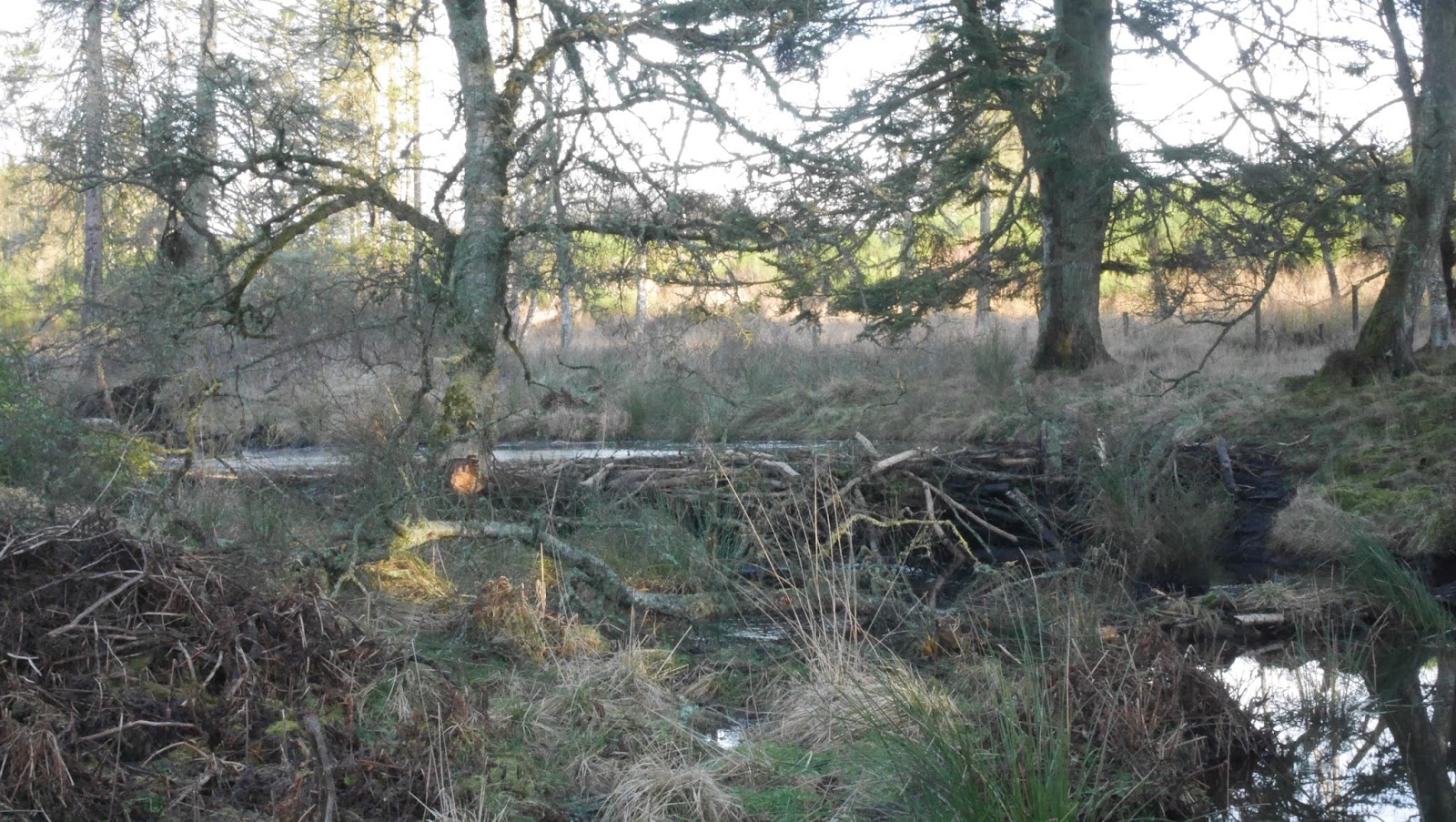
Middle to the second half of January: most ewes should be pregnant by now and many will be bearing twins. I reach the end of the field and prepare to cross the fence. Placing my right hand on the top of a fence post, I raise my left leg to place my boot on the top wire and, drawing my right leg up to join the left leg, push up. My left hand swings over and places my stick on the other side, ready for landing. Over I go. With a light leap I touch down safely and climb the embankment onto the farm road and set off for the Quarry Wood. The path through it is clear since the Wild Sparks started, but there is no one about today: no sounds of children busy in the woodland. I cross another fence and make my way towards the wetland. A woodcock flies out from the undergrowth near me. The afternoon sun is still above the horizon and the landscape around me glows. Turning left I make my way towards the long dam. Usually I walk along the crest, but today I do not: the beavers have taken advantage of the open weather and have spent much time repairing it and raising its height. Mud has been dredged from the floor of the pool and slapped onto the dam wall. They have added sticks, mostly brushwood, and in some places small branches along the top. To tread on this structure would be to risk damaging it.

A pair of mallards flies up, interrupting my concentration for a moment as I make my way through the rushes. This demands some care because there are hidden channels up to a couple of feet deep.  

I walk on and note that the beavers have diverted one of their canals to create new pools. Another woodcock sweeps off. As I pause to look around a red squirrel appears: it has probably been eating alder seeds. Ravens croak and I look up to see a couple of the birds flying over. I walk on and another pair of mallards irrupts into the sky, quacking their warning to the world. By this time I have more or less completed my customary circuit and am crossing a dam. ‘Plop!’ What was that? Too small for a beaver: I look at the disturbed surface of the pool and wait. Moments pass: a beast raises its head from the water some yards away. It looks about, submerges and swims off: it is a water vole. I wait on, hoping to see the animal again. There are some ripples in the water and a sound of gnawing somewhere else, but the creature has gone. It has been a long time since I last saw a water vole and I am glad to see one about.'


This photograph shows huge bubbles in the foam that aquatic hyphomycetes produce during their breaking down of leaf litter in the Burnieshead Burn. I first learned about these fungi when attending a meeting of the Scottish Freshwater Group at Stirling University many years ago. 


Developments at the Burnieshead have been remarkable over the past year.


This is one of the new dams next to the drive to Bamff House.


The beavers in the Wet Wood have been active in repairs and alteration of their long dam, now more than 100 metres long.


The beavers have used a lot of brushwood gained from felling grey alders.


Further on in my walk I came across this place where beavers have diverted one of their canals to create new pools.


Here is a wide angle view, looking east through the wetland that resulted from the presence of beavers over the last 15 years.


A bit further east than the last photo in among some mainly grey alder woodland. 

December 2016 was a dry month, so it is interesting to see how the beavers have maintained and even raised the water level here this past autumn. 


Last winter I read John Pastor's wonderful book 'What Should A Clever Moose Eat?' Professor Pastor has a web site at http://www.theclevermoose.com. What more can I say?


Tuesday, 5 January 2016

January 2016 - A Walk along the Burnished Burn


Looking upstream from the drive to Bamff House.


And then, looking downstream along the Burnished Burn.


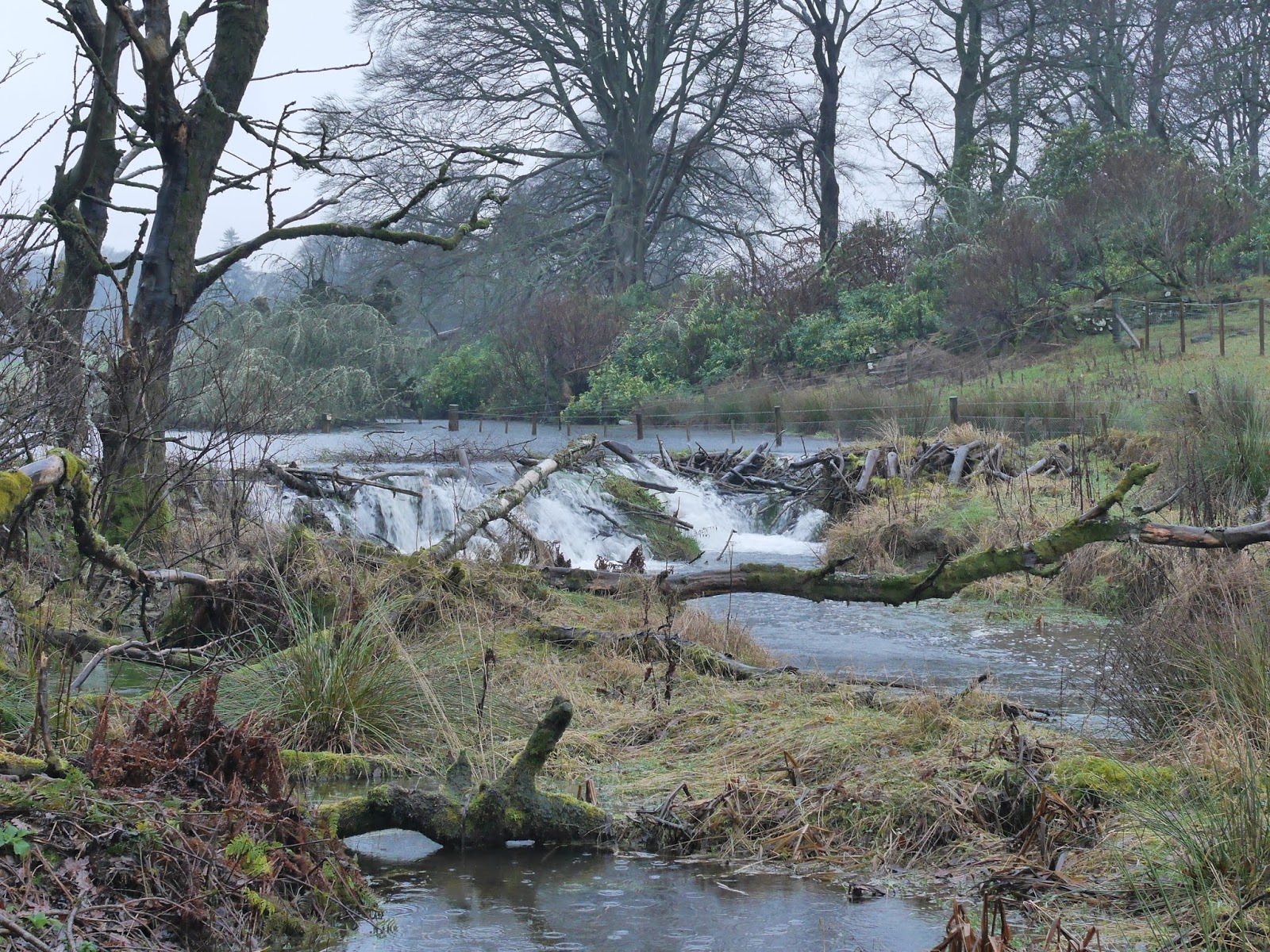
Here is the High Dam, which was breached twice last winter and repaired. It has held successfully so far. The inverted V is the repair from last year.

This side of the V is an accumulation of birch twigs and branches. I wonder if this is the cache that used to lie a little upstream, or whether it is reinforcement for the dam.


A pair of dippers is living along this stretch of the burn. Their song greets me from time to time when I walk along to visit the territory.


The High Dam from further down stream. 


Monday, 16 November 2015

Autumn 2015


Last summer we went to Brittany. At some point in our stay I remembered that beavers had been returned to Brittany in the 1960s. We drove towards the catchment of the Elez and found this sign near a lake. Freshwater pearl mussels and beavers! I had always thought the two species must coincide, not least because Peter Goodwin told me that he had seen banks of freshwater pearl mussels near beaver dams while on visits to the USA.


Now we return to November in Perthshire.


This is the famous top dam downstream of the drive at Bamff after the recent heavy rains.


Ambitious? Not really - it's just a willow.


This is part of a new complex of dams in the burn below the old and ruined gamekeeper's cottage at the Burnishead.


Monday, 7 September 2015

An Indian Summer?


On the way to the Wet Wood, a pool dammed by some reed sweet grass.


The simplestem bur reed has spread remarkably into the Wet Wood and down the Burnished Burn to flourish along its reaches. Jeremy Purseglove mentions the plant as an important one for wetland habitats in his 'Taming the Flood', first published around 1986 and republished with revisions and beautiful woodcuts this year. 


Summertime, a short spell of drought, and the canal is running more as a trickle than an engineering work along which branches may be floated.


Overall the work of the beavers has made the whole place wetter. My leaky trainer shoes confirmed this for me, though the undergrowth was too thick to see through.


The arrival of a hobby was an excitement of the summer at Bamff. Hobbies tend to be further south. They prey on fast birds such as swifts and swallows, but also dragonflies. Could an abundance of dragonflies at Bamff encourage them? I don't know, but swallows, martins and bats looking for invertebrate life over the ponds could well.


Friday, 21 August 2015

I Missed the Deadline for September's 'Alyth Voice'.

There you go. There is no latitude on the deadline even for the editor of 'The Alyth Voice'.

The Sting and the Buzz

I have taken to standing and waiting for the green figure to replace the red one at pedestrian crossings with traffic lights. It gives one a moment to stand and stare. As the Welsh poet WH Davies put it:

What is this life if, full of care,
We have no time to stand and stare.
No time to stand beneath the boughs
And stare as long as sheep or cows.
No time to see, when woods we pass,
Where squirrels hide their nuts in grass.
No time to see, in broad daylight,
Streams full of stars, like skies at night.
No time to turn at Beauty's glance,
And watch her feet, how they can dance.
No time to wait till her mouth can
Enrich that smile her eyes began.
A poor life this if, full of care,
We have no time to stand and stare.

It was just at this moment, while waiting for permission to cross the road that I heard the sound of an angry group of herring gulls. Looking up from the display of pumpkins on the other side of the road, I saw a group of gulls, a regular hue and cry, chasing a buzzard. Well, I would not have been surprised at home, but this was Edinburgh.

Here we are in Edinburgh for a few days: going to the Festival and its Fringe, walking about, reading and writing. I love Edinburgh during the Festival. I like to see all the people going about, hearing all the different languages and the discussions. What of the performances? The Marriage of Figaro, performed by the Budapest Opera was a delight. I have been haunted by magical memories of the music for the last three days.

As to reading, I have just finished ‘A Buzz in the Meadow’ by Dave Goulson. Until a year or two ago, he was Professor of Biology at Stirling University (since moved to take up a chair at Sussex University). I wandered through his department once, while lost in a maze of corridors, looking for another Dave (Dave Gilvear, a professor of fluvial geomorphology). The walls were adorned with beautiful photographs of bumble bees. Back home again, and on to the internet, I discovered the Bumblebee Conservation Trust, a charity Dave Goulson set up while at Stirling University to promote their conservation. 

Bumblebee numbers are declining: thirteen species became extinct in at least one country in Europe between 1950 and 2000. Why? The usual reasons are given: loss of habitat due to agricultural intensification, urban development and disease. Last year Goulson’s book ‘A Sting in the Tail’ was published to great acclaim. An interesting section describes the dependence of soft fruit growers in Strathmore on wild bumble bees to pollinate crops of raspberries and strawberries while at the same time buying in commercially reared bumblebees. The worry is that centrally reared bumble bees may be the bearers of disease to the native wild populations. 

This year Goulson has followed up his earlier success with ‘A Buzz in the Meadow’, another excellent and readable, but alarming work in which, among a great deal else, he describes his research on the effects of the neonicotinoid insecticides on bumblebees and their part in the Colony Collapse Disorder that so worries the keepers of honeybees. 

When they were first introduced in the 1980s the neonicotinoids were seen as  reassuring successors to the organochlorines (DDT.Dieldrin, etc.) of the 1950s-1970s, and the organ-phosphorus compounds of the 1980s to 90s. The neonics, as they are called for convenience, are very poisonous to insects, but less so to mammals, which has to be a good thing. Since the late 1990s, however, there has been increasing concern about their environmental impacts. Like the organochlorines they build up in the soil and can linger on in sediments under water. They cause initially subtle, but real damage to the nervous systems of bees. The worrying thing is that these pesticides are very widely used: as seed dressings for cereals and oil seed rape, and as sprays for soft fruit. Being systemic they penetrate right through the plant, making the whole thing poisonous to insects. This is fine if the insects are pests, but disastrous if the species affected include bees, and the other insect pollinators that enable us to continue to live on this planet.
Did the light go green? 


STV's Nature Nuts with Julian Clary went down very well. The filming that happened here took place last year some time, I think. Bob Smith took the part of paddler of the canoe


This is the 'High Dam' in full flow, taken about the 8th August.


Now we have a team from the RSPB filming beavers here. I am looking forward to seeing the results of their work.