Tuesday, 22 October 2013

Autumn Rains

The rains are here at last. The water levels have risen and pools that were dry all summer are now sparkling with water.


The summer is truly past, though the weather is still surprisingly warm.

This is the time to look back over the rush that was the summer and take stock. Louise has written up the contents of the Visitors' Book we started for people who came here to see beavers.


The summer of 2013 was a good one for beaver visitors at Bamff, and the beavers themselves were very obliging too, appearing to be viewed, photographed and filmed to the satisfaction of many.  
The first visitors were in early May, and they were Jason Clarke and family of Cool Cottages, who were delighted to see a beaver and wrote a great review for our holiday cottage here: http://coolcottagesscotland.com/the-cottages/family-fun/old-brew-house/.  After that we had Mark Thomson the Dundee vernacular poet and his partner Rachel plus wee lad Billy,  and step-daughter Annie and her partner Brian came on 17th May.  Here is Mark’s website:  http://www.markthomsonpoet.co.uk.  Some of the party saw beavers, but it got a bit late for Billy.  In the end Mark came back another time.  He says “Yep I did see them not with billy though I came up with a mate of mine and we seen 3 of them and 7 wild boar, whut a result to think they are just up thi road from kirriemuir. Is amazing, eh am so gled that eh met you guys an gave me thi opportunity ti see these magnificent animals.” Thanks Mark, and thanks for writing in the Scots vernacular. I wish more people did that.
Soon after that there was a visit of 50 students from Napier University who came for a daytime visit to see the habitat. Rachel Mitchell, a post graduate ecology student at Napier who is the daughter of Andrew Mitchell, our neighbour who is also the Bamff farmer, came with the group and assisted Paul in showing them round.   Not long after that a group of 23 came from Dundee Naturalists’ Society came one evening. Paul took them down to the pond with the telescope and, in spite of being such a large group, they were quiet enough to see several beavers.  

And that was when I started keeping better records.  The next group, on 29th May, were Wildcru from the University of Oxford http://www.wildcru.org – Dr Roo Campbell, Dr. Christos Astaras, Kirsten Bilham and a group of seven PG Diploma Students from the course in International Wildlife Conservation Practice.  This group came in daytime and reported having seen dams, felled trees, beaver lodges and tracks, voles, frogs, and various small birds.  They were very impressed with the landscape engineering, and generally felt it was great. All this group felt that legal protection would be needed at least until the species was re-established.


Charlie Nash spent several weeks of the summer, from 12th May,  making a beaver film at Bamff.  Charlie is studying Wildlife Film Making at the University of the West of England in conjunction with the BBC here: http://courses.uwe.ac.uk/D4P31/ and he chose to make his film about the Tay beavers. He based himself at Bamff for a fair bit of the summer, doing some volunteering in exchange for accommodation. The short film is now complete. It’s called ‘Beaver Fever’ and shows both sides of the debate, but does end up being more pro beaver than anti.  This is greatly helped by the wonderful footage of beavers and other wildlife which would make anyone want to have beavers. 
            There were a few more visitors after that, one of whom, Patrick Cooper, reported seeing 4 beavers (we think) and a herd of wild boar. The comment in the visitors’ book was “inspiring for the future of British wildlife, and the overlapping of farming, ecology and farming.”
On 26th May we had a visit from a group from Baldragon Academy in Dundee. This small group, brought by their teacher David Wharton, had the good fortune to see not only beavers, but an otter hunting ducklings.  A first for us all! This was recorded on their own school radio programme.
Soon after a group of 13 volunteers came to stay with Donald McPhillimy, to do work in the woods, and their visit was enhanced by beaver watching. Most of them were lucky and had a sighting or two.


A third/fourth year student called Izzy Tween from St Andrews University spent some time camping at Bamff this summer while she conducted a survey of invertebrates in beaver pools and streams for her undergraduate dissertation in zoology.   She saw plenty of beavers in the course of her various visits.
On 4th June Tim Fison came with six members of the Aberfeldy branch of SWT, and had another good evening’s viewing.  The next group were relations, Robert and Cat Berry and they saw a few beavers and an otter. Cat wrote that this was a “much needed antidote to London. Very special indeed.” Next on 19th June, came Alasdair Gordon Cameron, a writer who is interested in rewilding came on 19th June.  He saw beavers and boar, and wrote “Fantastic – you have created something really wonderful.”  I have to say that I think the credit actually should go to the beavers, who have done all the hard work.  Next was a young Dutch volunteer worker, Brett Van Weeren – who was delighted to see beavers, deer and boar.  He said it was “Incredibly lovely! They seemed to live so peacefully.” Diane and Jan Hastie, saw deer, little grebe and blackcap, and Fi Martynoga, as Scottish Writer (http://www.amazon.co.uk/A-Handbook-Scotlands-Wild-Harvests/dp/1887354964)  saw roe deer, woodpeckers, dabchick & blackcap.


On 11th July we have our first recording of kits being sighted. Alison Handoll reported seeing two adult beavers and one or two kits. Sameena McMillan (on the same evening) saw an otter family walking on the path about a metre away. David Wilson (Freelance TV Producer/Director) went out late in the evening of the 19th July and saw three beavers and two rather surprised otters.
Jean Pierre Choisy, French Ecologist, involved with the reintroduction of vultures, ibex and chamois to the Vercor in France, and his daughter Elise and son Floris saw all three age classes of beaver (adult, sub-adult and kits). He wrote how remarkable it was to see the ponds created from a little stream with development of habitat for trout, water birds, and aquatic plants etc.
There was another large group on 2nd August, and the visitors kept coming through September as well. On the week-end of 5th/6th October Reforesting Scotland www.reforestingscotland.org held its annual conference in the Alyth area, and I took a large group round the beaver wetlands on the afternoon of 5th October.  Of three possible outings, the Bamff beavers (and other Bamff attractions, including Community Tree Cycle) proved overwhelmingly the most popular. Later there was a discussion in the Alyth Town Hall about re-wilding. A range of interesting views were expressed.  The way that beavers can re-wild the riparian corridor, even in an agricultural or urban landscapes greatly appealed to many of the members and there was widespread enthusiasm in spite of the beavers’ tree cutting habits. Members understood that tree cutting is not the same as deforestation.  
And the visitors have kept coming. Even this week we have some Dutch people in the cottage who are interested in seeing beavers, but as it’s so late in the year, they have so far only been able to hear them.


The first big dam along the Burnieshed below the drive is back into overflow mode.


Over at the Wet Wood the ponds are filling up again after a summer of drought.


This pool, bounded by the Longest Dam, has refilled with water.


Wednesday, 11 September 2013

Arboreal Beaver


On Sunday, 1st September, musicians from Jordan came to Bamff after their concert for peace in the Middle East in Edinburgh. They had professed interest in beavers, so I took them for a walk along the Burnieshed path. What a surprise when we came to the willow that overhands the path to find that a beaver had climbed the sloping trunk and started to gnaw an upper branch!


Here they are discussing the beaver's activities. Once you remember that beavers are more closely related to squirrels than to rats their interest in climbing does not seem so surprising. 


The same scene a few days later.


And again yesterday. Any progress?

Saturday, 24 August 2013

Health Check and Vegetation

The longer you leave it, the the harder it is to return, but here I am, back at the blogging.


Here is an ink cap, the first I have seen here this autumn.


The branching bur reed (Sparganium erectum) is a common aquatic plant, but I was delighted to see it in the temporarily dried out bit of the big pool in the Wet Wood. It is the first time I have seen it, and so much of it at that, in that area.


The beavers of the Wet Wood are very active now, preparing for winter. This ash (Fraxinus excelsior) was cut earlier in the year and has pushed out abundant coppice shoots, which have be browsed by roe deer.


Our most momentous event took place here in the first days of August, when the RZSS team came to do health checks on beaver here.

This is the article I wrote for the September number of the 'Alyth Voice'.


The swifts flew out one day during the first week of August. That is their wont and it marks the beginning of the end of summer. 

A day or two before the departure of the swifts the Royal Zoological Society of Scotand team came to Bamff on behalf of the Tayside Beaver Study Group to carry out health checks on any of the beavers here that had walked into their traps.  The chip shed had been prepared for the examination: the BBC crew that came to film for the One Show was in place.

'The first beaver to oblige was presented for examination on the 3rd of August. He turned out to be a young male of around 12kg. The high spot of the examination was a laparoscopy to study his liver. There has been some anxiety in official quarters that the beavers in the Tay might might be sources of a tape worm (Echinococcus multilocularis) that has been making its way through Europe. 

After the animal had been brought to the operating table ( it had been caught the previous day and spent the night in a beaver proof pen) and anaesthetised, the vet, Dr. Romaine Pizzi, carried out various procedures, including an ultra-sound scan, and then the laparoscopy. To do this, he cut away the belly wool. Then, after swabbing the area where he was to make the insertion, he made a small cut through the abdominal wall of the beaver and inserted a trocar ( a hollow pipe with a sharp end) and inserted his camera laparoscope through it. The monitor standing next the operating table now revealed live video of the internal organs of the animal. The liver was its proper clean purply  brown (so, no sign of infection by that worm which damages the liver seriously), and between the lobes he pointed out the spleen. As Dr. Pizzi moved the laparoscope around we could see clearly the large intestine. He pointed out the pelvis and the spermatic cord and, when he moved the camera up, we could make out the pulsations of the beating heart. All this was fascinating, made even more so by the commentary as Dr Pizzi answered questions that the interviewer from the One Programme asked. I was impressed above all by the sensitivity and respect with which Romaine carried out his work on the living animal, pointing out interesting adaptations that beavers had evolved to carry on their aquatic way of life. Apart from the laparoscopy, samples were taken of blood, faeces, anal gland secretions (this last for sexing the animal) as well as castoreum. Once all this was over, the mask which delivered the anaesthetic was removed from the beaver’s muzzle and the animal recovered consciousness. It was carried to the pen and left for a few hours to recover before being returned to its wetland home. 

The next day another beaver that had walked into a trap came in for its health check. Judging from his size and colour, I think he may well be the male that came to us from Bavaria in 2004. The same procedures were undertaken and, once again, we were excited to look at the insides of a living animal: the healthy liver, the gentle peristaltic movement of the large intestine with its branching networks of blood vessels. As on the day before, we looked at and handled the scaly tail of the animal and studied the webbed hind paws with the split nail that enables beavers to groom themselves so carefully. The beaver’s tail stores fat for the winter as well as being used as a rudder and diving plane with occasional use for propulsion. Both animals had fed well through the summer and their tails felt firm and strong.

Once the checks were over, the animal was awoken and, after giving him some time to recover,  was taken back to the place where he had been trapped, and released. This beaver, an adult male of 22kg, needed no persuasion to leave the carrying crate in which he had been moved and disappeared quickly into the waters from which he had come, leaving a trail of bubbles behind him.' 


Here are some of the photographs I took at the time.


Milking the anal glands for their secretion. Colour and consistency give a reliable indication of the beaver's sex.


That scaly tail - how did I miss the tip! 


Fur cut away before the laparoscopy.


The dense underfur that so nearly proved the undoing of the species.


The veterinary surgeon at work.


The monitor shows the healthy liver and spleen.


A length of large intestine.


Back to the water!

Thursday, 1 August 2013

A dry spell for a change! Izzy Tween, a fourth year student from St.Andrews, came to survey the invertebrates of the beaver pools in the Burnieshed Burn. She needed a comparable ditch as a control, so I suggested the only ditch that is comparable.

Here are some photographs of the ditch that runs from the ditch that runs along the north side of the Burnieshed field. These photographs were taken when it was already fairly dry - 2 June.


And here are some photographs of the corresponding stretch of former ditch inhabited by beavers on the south side of the Big Burnieshed Field, as we call it with our creative imaginations:


This photo was taken on the 2nd of June, already a time of drought.


As you see from the foxglove on the right, this photo was taken in July.


As was this.

Starting to post again after a gap of more than a month is difficult: so much has happened it is hard to know where to begin.


Wednesday, 22 May 2013

'Summer at Last' and Photographs of the Rewilding Wetwood at Bamff.


The following quotation appeared on the BBC News web site today and figured on this morning's news on Radio 4 several times. One of those interviewed on BBC TV's morning news programme told us that the great decline of species of plant and animal had begun in 1970, the year of his birth. I remember this year so well because it was the year that I graduated from the MSc course at University College London.


'A stocktake of UK nature suggests 60% of animal and plant species have declined in the past 50 years - and one in 10 could end up disappearing.'


Below is my latest article for the Alyth Voice: 


'Two swallows do not make a summer, as the saying has it, but the arrivals of chiff-chaff, willow warblers, swifts and  cuckoo are definitive. Whatever we may think, summer has arrived and the grass though late and slow to grow is on the move.

Do you ever have trouble settling down to write something: an article or a letter, for example? I could not set about my piece for this month's 'Voice', so I decided to go for a walk to clear my head.

I left the house, walking into a mild air: swallows swirled up ahead of me, twisting and turning as they hunted for insects. Two of the birds were sitting on a telephone wire: one held a feather in its bill. I looked into an outbuilding, whose time and weather warped door makes it hard to shut, and saw three nests from past years and the new nest freshly daubed with mud.

Blackbirds sang as I walked and as I walked I reflected on the state of things. My immediate purpose was to check on regeneration of seedlings in the compartment that was felled last year. I passed the Beaver Pool next the drive with its pair of mallard and moved into the dark of the Tay Bridge Wood fringed with rhododendron. Chiff chaffs sang vigorously and, as I rounded the corner of the drive to see the straight length ahead, I became aware of the misty green light cast by the birch as it comes into leaf. Thinking about this, and remembering the opinion of the friend who likened the view from this point to paintings by artists of the early 19th Century Hudson River School (http://en.wikipedia.org/wiki/Hudson_River_School), I turned to look at the swamp. Something, hidden in the mass of fallen trees, was gnawing something.

A cough from behind announced the presence of Chris Potter. He had some excellent news: a pair of peewits had hatched a brood of kits in a rushy patch that has resulted from the activity of beavers downstream. I was thrilled to hear this because, to the best of my knowledge, no peewits have bred at Bamff for at least ten years. The peewit is one of those species whose decline since the Second World War has been dramatic and linked to loss of habitat due to drainage of wetlands. Rewilding is one of the chief benefits of the presence of beavers, so the return of peewits to Bamff is an important moment. Let us hope they raise their brood successfully and that what is happening here is repeated eventually all over Scotland
I moved on into the cleared compartment. Nearer the west there were plenty of little birch seedlings among the ground flora, which included sheep sorrel, a legume of some kind (perhaps young birds foot trefoil?), broom, foxglove rosettes and a whole lot of grasses. A greater spotted woodpecker flew over and paused to examine the bark of a pine tree. It cannot have found much because it flew off again only moments after it had landed. All around me the blackbirds sang.


Enough of speculation! I continued on my way, pausing only to look for birch seedlings and to retie my shoe laces. Soon, however, it was time to head for home and take up my duties of the evening as cook.'


Some photographs from the rewilding area of the Wet Wood.

Tuesday, 21 May 2013

Rebraiding Waterway and Rushy Patch


The first photograph shows a bit of rebraiding of the Burnieshed Burn. The old ditch is seen as a straight brown line, running east from the dam. A sluice in the middle of the dam diverts water from the pool and flows into the main ditch. At the southern end of the dam a canal is gradually being extended - to where we shall have to wait and see.


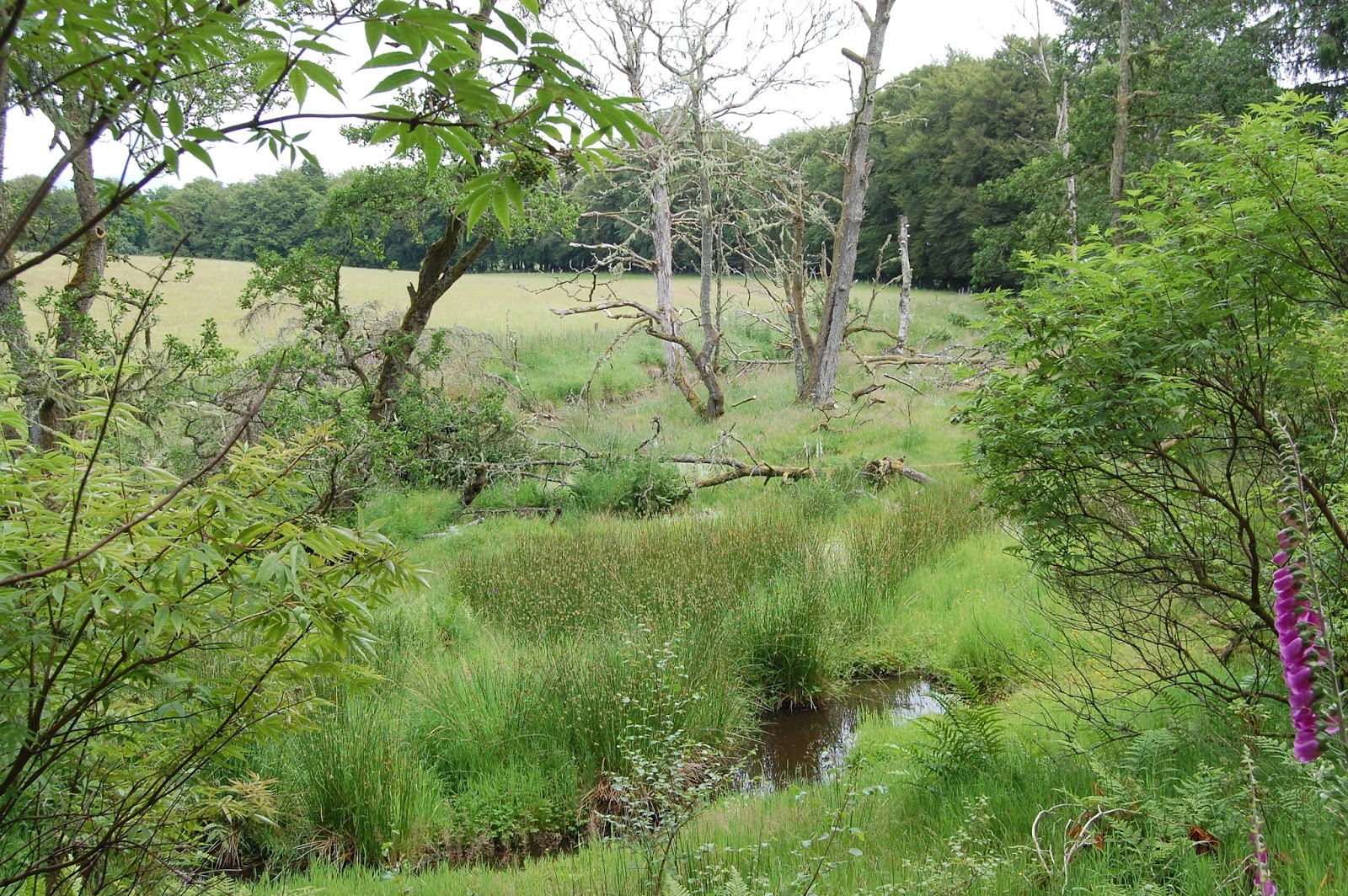
The rushy patch is where a pair of lapwings have nested. The wet area has resulted from backing up of water from the Big Ponds, where the water level has risen greatly in the last years but particularly since last year's rains.

Monday, 20 May 2013

Good News from Bamff - the Peewits Return


The news that peewits were breeding here at Bamff, and that their chicks have now hatched, was very exciting. All the more so because the place the pair chose for their nest was a wet patch in a field that has grown as a result of the beavers' activities downstream. The return of wetland birds, such as the lapwing, whose numbers have been very much reduced in the British Isles in the last thirty years is most welcome.

I nearly forgot to say that peewits have not bred here for at least ten years. Having said that there is a long way to go between hatching out some chicks and having them fledge and fly away. 


A recent digiscoped photo of a beaver in the Big Pond area. 


The same animal a few moments later. These photos were taken with an iPhone looking through a telescope. Later they were cropped to remove the vignetting. 


Another effort at a pond leveller: the outlet is too near the dam, I think. Some time we shall attach another length of pipe to it to protect the outlet from being stuffed by beavers when they have added to the dam.