Tuesday, 21 May 2013

Rebraiding Waterway and Rushy Patch


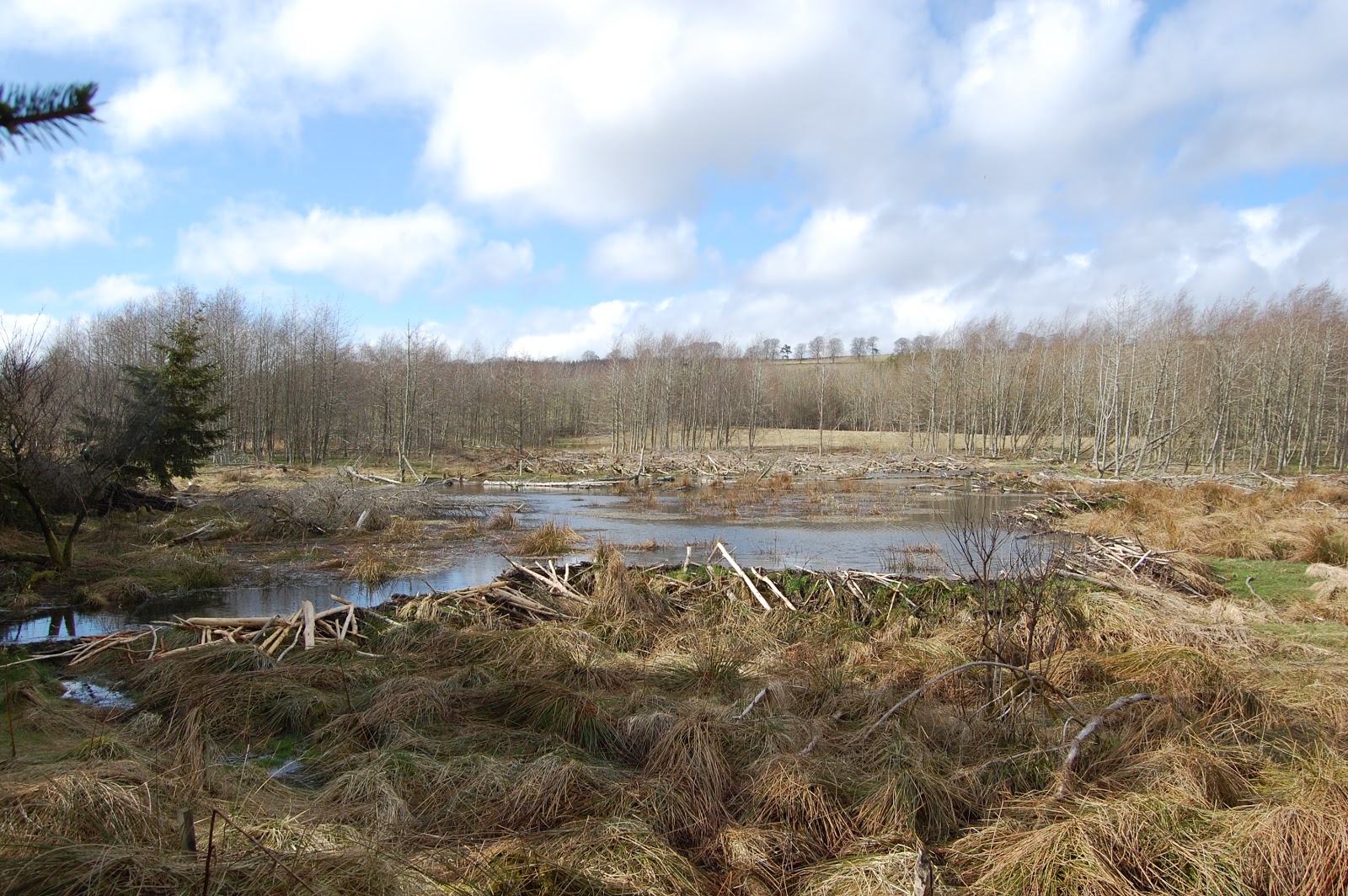
The first photograph shows a bit of rebraiding of the Burnieshed Burn. The old ditch is seen as a straight brown line, running east from the dam. A sluice in the middle of the dam diverts water from the pool and flows into the main ditch. At the southern end of the dam a canal is gradually being extended - to where we shall have to wait and see.


The rushy patch is where a pair of lapwings have nested. The wet area has resulted from backing up of water from the Big Ponds, where the water level has risen greatly in the last years but particularly since last year's rains.

Monday, 20 May 2013

Good News from Bamff - the Peewits Return


The news that peewits were breeding here at Bamff, and that their chicks have now hatched, was very exciting. All the more so because the place the pair chose for their nest was a wet patch in a field that has grown as a result of the beavers' activities downstream. The return of wetland birds, such as the lapwing, whose numbers have been very much reduced in the British Isles in the last thirty years is most welcome.

I nearly forgot to say that peewits have not bred here for at least ten years. Having said that there is a long way to go between hatching out some chicks and having them fledge and fly away. 


A recent digiscoped photo of a beaver in the Big Pond area. 


The same animal a few moments later. These photos were taken with an iPhone looking through a telescope. Later they were cropped to remove the vignetting. 


Another effort at a pond leveller: the outlet is too near the dam, I think. Some time we shall attach another length of pipe to it to protect the outlet from being stuffed by beavers when they have added to the dam.


Thursday, 18 April 2013

The Long Dam


A roaring kind of Spring has arrived, even if a month late. Snowdrops are still in full blossom and the daffodils are still in bud.


The big dam in the Wet Wood has been extended a bit at its southern end (not to be seen in this photograph).


 Nor does this photo show the extreme southern extension, but is taken from just south of the ditch where the first little plug was built to block it eleven years ago.

I must go out and photograph the southern end and the paths that lead into the plantation.


Thursday, 28 March 2013

Wild Boars and Snowscapes of Beaverdom.


Here, just for a change, is a photo of some wild boar.


Back to the Wet Wood at Bamff and the beavers who live there.
This is a dammed area at the west end, where the beavers have dammed water coming from one of the ponds that was dug in the autumn of 2001. A canal leads from the pond in question through to the big expanse of water that the beavers have created with their Long Dam (about 100 metres).


I took this photo with the panoramic facility of my iPhone. It shows the Long Dam I mentioned above and the pond thereby created.


This photo shows the small pond in the middle distance. A ditch dug in the early nineties, or even earlier leads the eye to a trap, not yet set, that is going to catch a beaver for blood sampling as part of the Tayside Beaver Study Group's work of monitoring the beavers of the Tay.


Easter is early this year, but I don't remember a white Easter here, although we do get snow until May sometimes. My first lambing here, in 1981, was made more interesting by heavy snow falls. Luckily, the snow soon melted.

Saturday, 9 March 2013


Now, here's a thing. While we were in Oregon in January, attending the State of the Beaver Conference, Paul Henson of the Oregon Wildlife and Fisheries Department spoke about surrogate species. He was keen that the beaver should be seen as a surrogate species. I have pasted in Heidi's Call to Action below, which explains 'surrogate species' as a technical term.


From: Heidi Perryman [mailto:hdshrnkr@comcast.net]Sent: Monday, March 04, 2013 11:18 AMTo: 'beavers@surcp.org'Subject: Recommending Beaver as a Surrogate species - Don't forget!

   Posted by heidi08 On March - 4 - 2013
 << OLE Object: Picture (Device Independent Bitmap) >> After the State of the Beaver Conference, I talked mentioned the mandate for Fish and Wildlife services to focus its efforts on a few key ‘SURROGATE SPECIES‘. State supervisor Paul Henson had recommended we think about beaver in this role, and asked for public comment. Since there are about 25 days left for your comments to be submitted, I thought I would offer some reminders and encouragement.
In case you slept through that biology class lecture, a SURROGATE SPECIES is defined thusly:
A species selected as a priority for conservation with the assumption that its conservation will serve to protect many other species with overlapping habitat requirements.
This is a tool for monitoring ecological systems, although obviously not a perfect tool. Just as following the regional price of cardboard will tell you something about the amount of shipping that occurs in the US, but it won’t tell you everything you need to know about the economy, for example. It has been successfully argued that watching ONE token species often misses important impacts to others.
Case in point, if we were to watch beavers as a surrogate species, we would have a good chance at learning about conditions for salmon and birds and dragonflies – but if there were a specific toxin introduced to the water that killed fish and everything that ate them, we might not find out about it at all from watching beavers. Fair enough. As a tool it has its limits. However, if we routinely destroy beaver dams we can assume that all the species that depend on them will be dramatically impacted, even if the food chain is preserved. So surrogacy has an undeniable value.
There are several types of surrogate species, including
Umbrella Species:
Where the conservation goal is to protect a habitat or community of species, an umbrella species may be employed as a surrogate to delineate the size of area or type of habitat over which protection should occur.
Flagship Species:
Flagship species are used to attract the attention of the public Flagship species can garner sympathy for nature at a global level, as in the case of the giant panda, the emblem for the World Wide Fund for Nature, or at a national level.
Indicator Species:
Defined “an indicator species [as]an organism whose characteristics (e.g., presence or absence, population density, dispersion, reproductive success) are used as an index of attributes too difficult, inconvenient, or expensive to measure for other species or environmental conditions of interest.” This can include Health Indicator Species, Population Indicator species, and Biodiversity Indicator Species.
I would argue that beaver dams and the wetlands they create, (as well as beaver chewing and subsequent coppicing), make them is an excellent candidate for Biodiversity Indicator Species, as well as an Umbrella species, and as it happens, (In Martinez and the entire Bay Area for nearly two years) a powerful Flagship species to boot. The effect of our beavers on our tiny urban stream is still being measured,  and there is reason to think that if every city took care of its beavers, every city would have this and more:
 << OLE Object: Picture (Device Independent Bitmap) >> In addition to creating habitat for these and countless other species, I would add that beavers make an excellent SURROGATE SPECIES because they leave clues that are convenient for burdened agencies to track track down. You don’t have to install night cams or get up at 3 in the morning to keep track of beaver. You just need to count dams and chews whenever you can get around to it and keep your eyes open. Even though they can be hard to see, beavers are actually fairly easy to monitor.
Need a few more reasons? In addition to being a Keystone species, beavers are also considered a Charismatic Species which means that children and adults LOVE to learn about them. They can help teachers convey difficult concepts like habitat and ecosystems, which is why they were included in the EPA curriculum for every first grader in California. Beavers also teach problem solving skills, since their challenges are so easily solvable that it might inspire folks to solve other wildlife problems in humane ways.
Last reason? CLIMATE CHANGE.
With more than half of the contiguous States in the U.S. identified under extreme drought conditions last year, we are should be more protective than ever of our natural water-savers. Drought conditions are recognized by FEMA as a natural disaster, making counties eligible for federal funds to recover crops, cattle and neighborhoods destroyed by dry conditions. Beavers and their remarkable capacity for water-tending,  are one of the only renewable resources we can deploy to successfully combat this ongoing crisis.
__________________________________________________________
I know you’re busy, and life is full of demands. But 431 people read this website on Friday and you each have the power to make a huge difference in the lives of beavers. Fill out the form, or submit your comments here. And if you do let us know, and we would be thrilled to post all or part of your comments on the website to show what a beaver community is capable of.
 << OLE Object: Picture (Device Independent Bitmap) >>


Wednesday, 6 March 2013

Beavers along the Dean Water where it flows under the A90 near Forfar Loch.

I forget when word reached us that some poplars by the Dean Water, where that stream flows under the A90, were thought to be in danger of being felled onto that road by beavers. 

Nobody seemed to know whose land the trees were on and so no one was sure whose responsibility it was to do something about the trees.

So nobody did anything about the poplars until BEAR decided to fell such trees as might fall over the A90 if felled by the beavers.

As everyone knows the poplar genus is the beaver's favourite.


We approached the place of the poplars by way of the Forfar Loch (where we saw fresh evidence of the presence of beavers: cut willows that will coppice in the spring). This photograph shows the Dean Water as it flows out of the Loch. 

Originally, the Forfar Loch stretched as far as Glamis (only a few miles downstream), but draining for agriculture started, I think, in the seventeenth century. The Dean Water was canalised and deepened to drain the loch. The soils are fertile, but very prone to flooding.


We crossed the A90


and approached the clump of poplars and alders. 


It wasn't long before we saw trees that the beavers had felled.


Most, if not all the trees had been numbered, though why this willow had been treated in this way I do not know.


A Bavarian beaver trap had been set as part of the Tay Beaver Study Group's monitoring programme and a trail camera had been placed by the tree behind it, as you can see in the next photo.


Looking down the Dean Water.


This is one of those charming, forgotten fragments of land that, as it seems, belongs to nobody.


Here you can see signs of beaver burrows. Much of the digging must have been done to escape from flood waters through the winter. There is also a handsome food cache in the water.


These poplars were the ones nearest to the road. You can see a lorry on the sky line. 

It seems to me that all these trees could be protected with rabbit netting fixed round the base of the trunk , pinned down at the bottom and supported by a couple of rebars. 

Roadworks by the Bamff Drive


At last, the decision had to be made to do something about the dam in the distance. 


The beavers had rebuilt it after its breaching at the time of the logging of the Whitehills Plantation this time last year. Then, with all the rain, snow, snow-melt and more rain, they had gone on building up the dam so that the drive was lower than the water level at the dam. All this was continuing after the work of mitigation that we had carried out lower down the dam to protect the lodge at the end of the drive.


Water was increasingly running down the drive.


Lewis Smith (Lush) and his colleague, Terry, were keen to instal pond levellers, but felt that more radical action was necessary. Stewart Crabbe, the top of whose head is missing in the photograph on the right, found that the old stone culvert that drained the Big Pond was dug in very low. It would be necessary to unblock the culvert, in which case the dam below could not be allowed to be rebuilt, or to instal a new pipe under the drive, but lying over the old culvert. I was keen for the dam to be restored as much as would be consistent with a dry drive.

Accordingly, a pump was set to work to drain the pool that you see in the top two photographs and the dam was dismantled with great care to avoid sudden collapse. Next, Stewart Crabbe excavated the channel that leads to what had become the dammed pool.


Then the drive was dug up.


And the new pipe was installed.


Downstream, the dam had been lowered to the bed of the ditch.


Would the beavers return to rebuild, or would they move off?


By Monday we had the answer: the beavers had begun to rebuild their dam. It remains now to decide at what level to instal a flow device. 

I should say that the drop in the level of the water in the channel revealed a burrow, so the beavers will be keen to cover signs of its existence.