Wednesday, 6 March 2013

Roadworks by the Bamff Drive


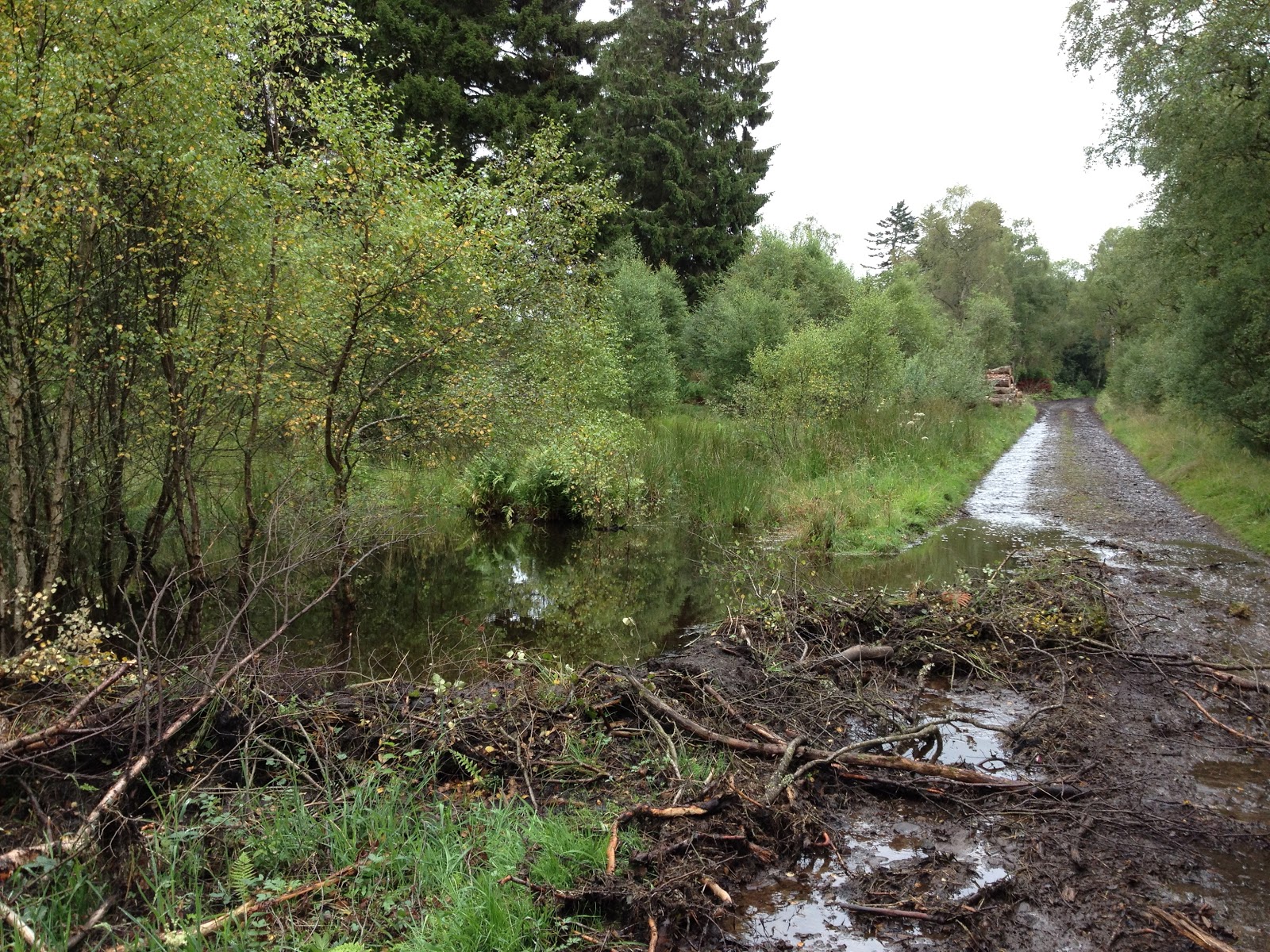
At last, the decision had to be made to do something about the dam in the distance. 


The beavers had rebuilt it after its breaching at the time of the logging of the Whitehills Plantation this time last year. Then, with all the rain, snow, snow-melt and more rain, they had gone on building up the dam so that the drive was lower than the water level at the dam. All this was continuing after the work of mitigation that we had carried out lower down the dam to protect the lodge at the end of the drive.


Water was increasingly running down the drive.


Lewis Smith (Lush) and his colleague, Terry, were keen to instal pond levellers, but felt that more radical action was necessary. Stewart Crabbe, the top of whose head is missing in the photograph on the right, found that the old stone culvert that drained the Big Pond was dug in very low. It would be necessary to unblock the culvert, in which case the dam below could not be allowed to be rebuilt, or to instal a new pipe under the drive, but lying over the old culvert. I was keen for the dam to be restored as much as would be consistent with a dry drive.

Accordingly, a pump was set to work to drain the pool that you see in the top two photographs and the dam was dismantled with great care to avoid sudden collapse. Next, Stewart Crabbe excavated the channel that leads to what had become the dammed pool.


Then the drive was dug up.


And the new pipe was installed.


Downstream, the dam had been lowered to the bed of the ditch.


Would the beavers return to rebuild, or would they move off?


By Monday we had the answer: the beavers had begun to rebuild their dam. It remains now to decide at what level to instal a flow device. 

I should say that the drop in the level of the water in the channel revealed a burrow, so the beavers will be keen to cover signs of its existence.

Saturday, 23 February 2013

Pond Levellers, flood mitigation measures and some dams.


The photographs and map in this post are here to tell the story of some attempts to manage affairs to the convenience of the humans who live here, but not forgetting the well-being of the beavers.

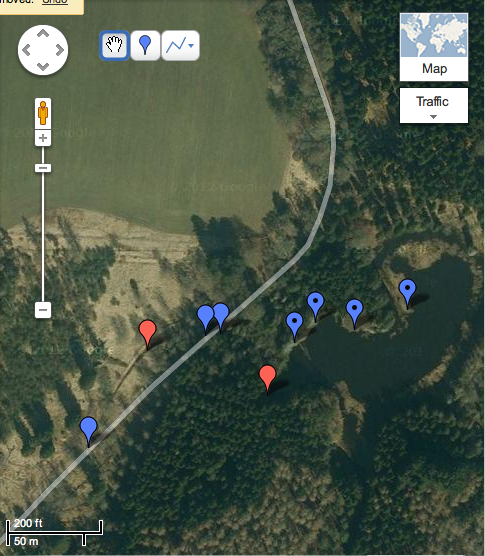
Nearly a year ago the plantation woodlands in the southern part or bottom of the Google photo below were to be felled. The contractor was anxious that his trucks/lorries would damage the drive (the white line running through the photo), particularly as some water was overflowing damming that beavers had done west of the drive at the place marked by the two red markers. 

I should mention that the drive was built in the 1840s with horse drawn carriages in mind. The traffic of lorries weighed down with loads of timber and the destruction this can bring was not thought of at the time. The consequences of tracked vehicles travelling on such a road were unimagined. 

Until recently it was possible to stack felled timber by the side of public roads, but this is no longer allowed.

To cut the story short the dam was breached by the contractor and water flooded down the drive.

The beavers began immediately to rebuild this dam, providing a great opportunity for my trail camera.


At the same time the contractor started to fell timber and stack it by the side of the drive, some of it blocking the old culvert at the lowest blue blob on the satellite photo. The beavers responded to the flow of water that now ran down the west side of the drive by damming it. Eventually, the topography of the land demanded that the water flow across the drive and the beavers began to dam the drive itself. 


All this during a very wet summer: in due course all the timber was removed and the blocked culvert was cleared. 


In December 2012 heavy falls of rain caused the barrage that closes the ponds to the east of the drive to overflow. This caused flooding in the cellar of the gate lodge (to distinguish it from the beaver lodges) at the southern end of the drive. Heavy (relatively speaking) snow in conditions of thaw caused more flooding in January. We arranged for a digger to come and clear a ditch just north of the lodge. This has cured the problem for the time being, but we need still to do some work on the water levels upstream.


This photograph, looking roughly east across the main pond, shows where beavers are keeping the water open as they swim back and forth. It was taken from the furthest right of the blue blobs.


One of the lodges is shown by the blue blob, second from the right on the satellite photo.


Large woody debris in prone, vertical and angular states, seen from the barrage that closes these ponds.


The barrage that created these ponds was built in the 1890s, I think. It was planted during the 1950s with Norway Spruce, whose rooting systems have been drowned by the raising of the water level brought about by the beavers. 


A few metres on. The dead trees, infested by wood boring wasps, have snapped in the wind rather than been upended on their roots. 


The sluice for the barrage is at its southern end. Since 2002 the beavers have kept it dammed. 


During the various recent attempts to lower water levels a notch was made in the dammed part of the sluice, releasing a great deal of water. As you can see, beavers have been back to repair the damage done to their work by humans.

The last two photographs are roughly where the right of the two red blobs is place on the Google image.


The sluice from downstream.


Looking downstream from the area of the sluice across the swamp.


This photo shows a small enclosure, almost a primitive attempt at a 'beaver deceiver', which marks the entrance to a culvert that goes under the drive. The beavers never tried to block this culvert, so far as I am aware, but raised water levels from the dams downstream made this unnecessary.

The right of the two clear blue blobs marks this on the Google map.


The culvert's outlet is marked by the hole in the ice nearest the camera. There is another hole some yards on and the clear water beyond the felled birch tree marks the beginning of a deeply dug ditch with embankments. The left of the two clear blue blobs marks the emerging place of the culvert.


This is the top dam of that big ditch. A notch has been made in the middle of the dam and the water level has been considerably reduced. Should this be the place for a pond levelling pipe and cage to be installed?


The east side of the dam runs along the bank of the embanked ditch. You may be able to make out the notched bit of the dam that appeared in the previous photo.


A flight of small dams controls the water as it runs south along the ditch.


A small dam filters the water where the embankment has ceased.


The old stone culvert was intact, though somewhat silted, and lengths of plastic pipe were inserted at the inlet and outlet last summer.


This photo shows the line of the embanked ditch. The Google image shows it too if you look for it.


This is our first big attempt at mitigating the impact of beavers. It will be interesting to see how it goes.

In this situation the combination of wet weather through the summers of 2011, 2012, wet winters in both those years, coupled with timber operations, and the work of the beavers have brought about a situation that we need to manage. 


Saturday, 2 February 2013

Forests and Sea Lions

The interview in the current 'New Scientist' of Dekila Chungyalpa, director of the WWF's new Sacred Earth programme (http://www.newscientist.com/article/mg21729020.200-faith-leaders-belong-at-the-forefront-of-conservation.html?) reminded me that the State of the Beaver Conference started with a welcome from the Cow Creek Band of the Umpqua Indians, part of which included a prayer for the success of the conference. 

The reminder that many Indian groups have survived the last hundreds of years of expropriation, even though sometimes without their language as is the case of the Cow Creek Band, was fascinating to us. It was particularly good to learn of this Band's enthusiasm for the restoration of beavers in water conservation and the recovery of salmon in the Pacific North-West. 

We left the conference and stayed a night in Florence, after which we drove along the coast to the cave shown below.


This is a magnificent place, reached by an elevator (though in this case you descend to the cave), where Californian sea lions spend time resting on the rocks or swimming in the surf. The photograph shows a group of females battling with the waves as they rush into the cave. The males swim up to the Arctic at this time of year, we were told. The cave has a tremendous smell of fresh fish.


Our next stop was Newport. We booked in to a hotel and went for a walk along the beach. It was interesting to see the great amount of tree trunks that littered the beach, something that reminded me of  Chris Maser's book 'From the Forest to the Sea—A Story of Fallen Trees' (1988). Compared with many beaches in Scotland there was surprisingly little plastic rubbish.

As we drove along we noticed a sign to Beaver Creek, a state natural area. Stopping on the way to ask for directions from a woodman who was servicing his chain saw, we learned that there were no beavers in the area now. He claimed that farmers had killed them. However, the Google entry for the site stated that there are beavers around. Who is right? Our local informant or the Oregon Fish and Wildlife Service? http://www.oregonstateparks.org/park_261.php


At the lower level, the area was mainly wetland, but as we walked up the track open meadows became a feature of the forest landscape. It was clear from fresh droppings that there were many elk about (red deer to us) about. Our woodman had said that we could well see them, if we were around at dusk. 


You can see the Pacific Ocean in the distance. What was that about Stout Cortes on a peak in Darien?


On Sunday, 27th January, we visited Cape Perpetua.


Anyhow, remembering our visit to the beach at Newport with all those fallen trees, here are some standing trees at Cape Perpetua, which is part of the Siuslaw National Forest. It was wonderful to see  Sitka spruces, Douglas firs and Western Hemlocks in their native environment. I have googled the place since returning home and found that a particular Sitka there is known to be six hundred years old.  No doubt a number of others are just as old but did not have cores taken from them to prove it. I don't think the cored one was one of the giants that we saw, but they were impressive enough for us.


It was extraordinary to see these giant covered with mosses, lichens and ferns. How wretched our plantations look in comparison with these real forests!


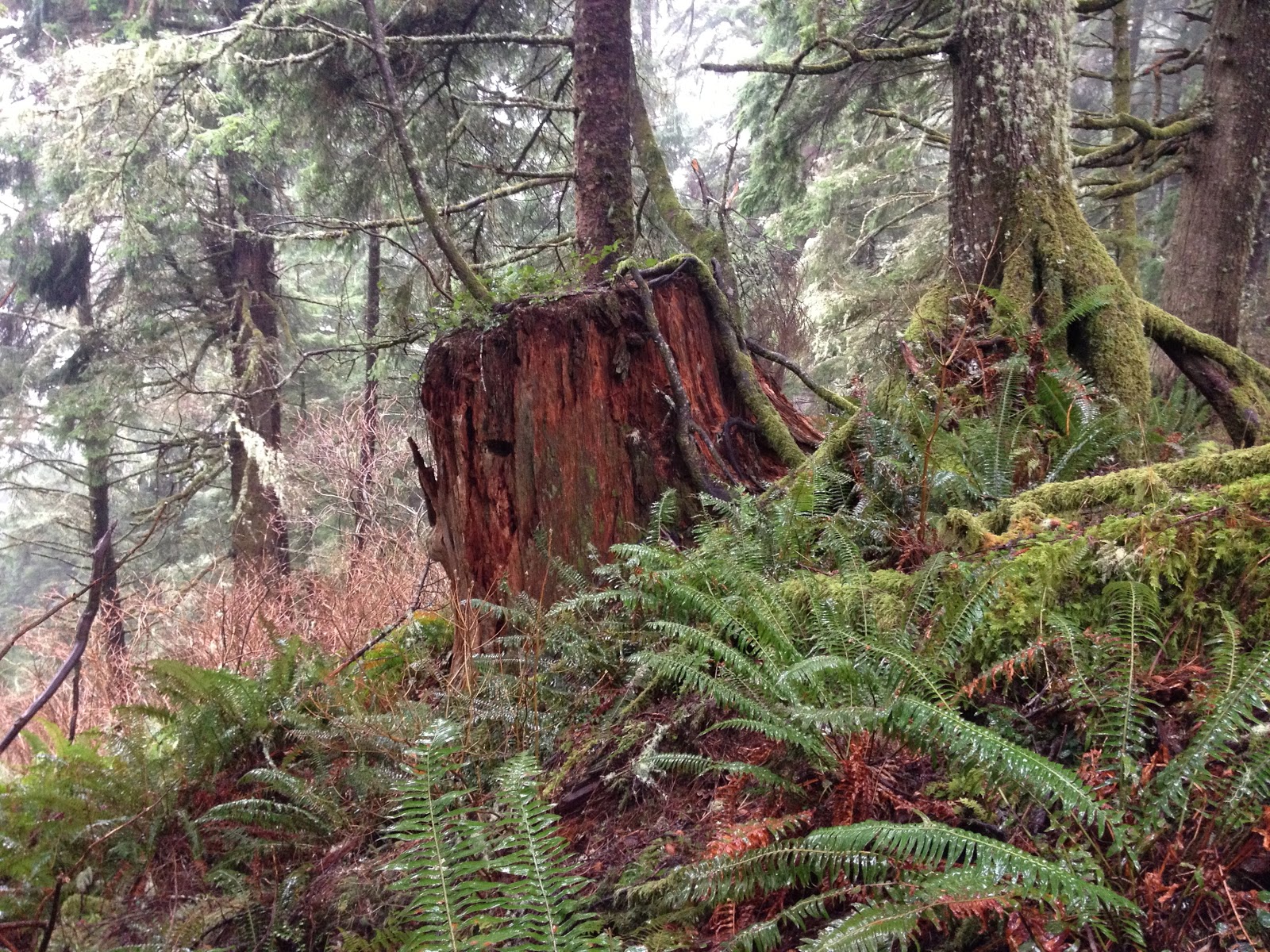
There were stumps of some giants. In some cases these stumps had young trees growing from them as in the picture below.


After our visit to Cape Perpetua we made our way up the Siuslaw valley, where some fishermen were out in the mist and rain, probably fishing for steelhead trout - the anadromous version of the rainbow trout (Oncorhynchus mykiss). I learned this last piece for information from Paul Jameson in Blairgowrie since getting home.

After Corvallis we joined the Interstate 5 and drove North through the rain to Portland where we spent a pleasant evening in a noisy but fashionable restaurant called Clyde Common. Then, the next morning, we rose at the usual absurdly early time for catching planes, passed through security, and were admitted to the departure gateway to the wait for the plane. There we engaged in conversation with a young woman whose surname is Cargill. We told her that the place name from which her name derives is in Perthshire and then, consulting google realised that the 17th Century covenanter, Donald Cargill (from whom her father claimed descent so she told us), came from Rattray, even nearer home. 


In due course we took off: here we are flying over the Rockies, I should think. By this time Louise was into a conversation with a lady banker. I concentrated on Anna Karenina, while listening from time to time to possible pressure points in the conversation. 

Levin was turned down by Kitty Scherbatsky and had returned to his estate. In the meantime my neighbours had agreed that the politicians were as much or more to blame than the bankers. Clinton had started the rot (she had not heard of the John Fortune and Bird interview of 2008 http://www.blogger.com/blogger.g?blogID=3695196655254960724#editor/target=post;postID=7461947344977900382) and our banking companion was not an admirer of President Obama. However, she did share her peanuts with us and that was something.

We arrived in Newark, caught our connection for Edinburgh, landed there early on the morning of the 29th and arrived home to find a great deal of snow and tales of heroic deeds.

That's all folks!


Thursday, 31 January 2013

The State of the Beaver Conference, Oregon

The first announcement that the State of the Beaver conference would be held in 2013 was published some time last summer. Louise and I were excited to be asked to speak at it, Louise as keynote speaker at the conference dinner, and I at one of the daytime sessions. In due course we prepared our presentations, Louise in good time, and I closer to the beginning of the conference than I should have.

Christmas  2012 passed and the New Year 2013. The weather changed from rainy to snowy. Then the forecasts began to predict heavy snow. Would we get to Oregon, or not?


Snow fell and I realised, looking at the weather forecast, that much more was predicted. We decided to drive to Edinburgh the day before our early flight on the 22nd January, packed and set off.

We arrived at Portland (PDX in airport lingo) rather late as a result of delays at Newark. Coming in to land at Newark is an extraordinary experience. In the East lies Manhatten, silhouetted against the Atlantic sky: between it and the airport is a vast urban desolation of concrete and fences: huge parks full of containers, trucks and every kind of industrial process. 

Eventually we took off for Portland and watched the bright lights of the east coast conurbation disappear in the darkness. 

After a comfortable night in a hotel at Salem we drove on to Canyonville and the Seven Feathers Casino, hotel and conference centre in time to register and prepare ourselves.


Stanley Petrowski presided as  master of ceremonies. Here he is welcoming us to the conference. It was great to renew acquaintanceships and friendships started two years ago: wonderful to meet so many people who have  been such a support to our campaign for the beavers of the Tay. Because the beaver is protected in so much of Europe there is, generally speaking, less need for the kind of advocacy and campaigning that is  surprisingly still necessary in the USA. We enjoyed many conversations with people, such as Kent Woodruff of the Methow Valley Relocation Project, who had come across similar difficulties and challenges to ours.

Mike Callahan of Beaver Solutions in Massachussetts was present and generously giving out copies of his DVD on how to instal pond levellers and other devices to mitigate flooding that beavers may cause.


On the evening of the second day of the conference we attended the dinner, a splendid affair with Louise as guest speaker. You can see her in the distance with Stan, setting up her computer before the party got under way.

The speech, by the way, was very well received not least, it being Burns' Nicht, for the quotation from one of the Bard's less well known songs, 'Cock up your Beaver'.
Here is a link to Heidi Perryman's take on the conference:


On the third day Kate Lundquist from the California Beaver Working Group gave a talk and used this slide, a concrete poem by the look of it, to illustrate a point.

The standard of presentations was very high, so I am very much looking forward to the publication of the proceedings in order to remind me of what we listened to and looked at.

A great part of the interest of the conference was in the diversity of the talks given. There were strictly scientific papers, such as those of Michael Pollock http://www.awra.org/proceedings/Summer2012/Riparian/doc/abs/MichaelPollock_d913a6db_8133.pdfand Rachel Malison (http://www.rmalison.com/research.html) and then there were the advocacy or campaigning talks of which Heidi's brilliant and rousing account of the Martinez beavers was a fine example. I should also mention Ann Chamberlain and Cindy Haws' excellent joint presentation on the last morning of the conference.

Paul Henson of the United States Fish and Wildlife Service spoke about the beaver as a surrogate species. I had never heard this term before, but it seems to cover similar ground to the term 'keystone species'. http://www.fws.gov/landscape-conservation/surrogate-species-faqs.html.


 If the beaver is adopted as a surrogate species in US conservation policy that will be an important step in its conservation. Let us hope!


I became aware of the work being done by the Grand Canyon Trust for beaver restoration at the State of the Beaver Conference in 2011. Mary O'Brien spoke about developments in this. http://etal.usu.edu/ICRRR/Beaver/2012/UWCC/BRAT_WMacfarlane_short.pdf
I remember being much excited by the photographs of green, lush vegetation growing on the banks of the creeks in Utah, where only desert had prevailed before the beavers came.


This is just a flavour of the many interesting presentations that were given at the State of the Beaver Conference. One of the most interesting aspects of the whole enterprise for us was the involvement and support for the conference given by the Cow Creek Band of the Umpqua Indians. 


Here is a photograph of Leonard Houston, one of the chief organisers of the conference, with Louise when we said our good-byes. Leonard gave a characteristically eloquent speech of introduction to the proceedings.


Southern Right Whales off Hermanus, South Africa


Absence in South Africa for rather more than three weeks has made for an unusually long gap in blog posts: that, and an occasional malfunction in the Blogger software which, though reported, brings no help.


After arriving in Cape Town, spending a night there and then heading for Hermanus, we had the good luck to fly out over Walker Bay in Evan Austin's Cessna to see Southern Right Whales.

These whales, almost driven to extinction,  have been protected since 1937.

I have just come across this fragment of what was meant to be a much longer post, but thought I would post it anyway.

Wednesday, 30 January 2013

Normal Service Resumed?

A very long gap since last November!


The first photo shows the Mid Dam along the Burnieshed burn, partly breached. The photograph was taken on Boxing Day.


This photo shows the top dam beside the drive, fully restored now since demolition last March. This picture was taken about the 14th January, before our visit to Oregon for the 'State of the Beaver conference, and before the dump of 21 inches of snow on or about the 23rd January. There will be more about both subjects later.

Saturday, 17 November 2012

Afore ye go...

IN the now far away days when 'just a wee deoch an doruis afore ye gang awa' was the order of the day, 'afore ye go' was the byword of 'Bell's Scotch Whisky'.

It being half way through November and the year passing away with speed, I guess it is time to catch up on the year.


This is the dam by the drive that the timber contractors breached in the Spring. The beavers have restored it completely.


Here is the work in progress.


And some more..

Autumn Watch was a triumph for the beaver in Scotland. It was great that the dams and beavers of Bamff and the Tay were covered. I enjoyed the bit with Roo Campbell and one of the Beeb's presenters canoeing along somewhere on the, well was it the Isla or the Earn?

The photography of the inside of a lodge at Aigas with a sleeping beaver and various spiders, water shrews et al. coming and going was wonderful.

For some reason that Blogger never helped with my computer has been giving an error message about using blogger this last nearly a month but, after a go with Cleanmymac, the error message had gone and all seems well.

Perhaps the posting on my blog will recover its earlier frequency?